

You know the feeling: a minor, seemingly harmless comment from a coworker or spouse suddenly triggers a massive wave of anger, anxiety, or despair. It feels like a different person takes over your mind, dragging you into a vicious cycle of obsessive negative thoughts and toxic arguments. You are not losing your sanity. You are simply experiencing an active pain body.

Understanding the mechanics of this emotional reflex is the first step toward reclaiming your peace of mind.
Decoding the Concept: What is the Pain Body?
If you want to stop reacting impulsively to past trauma, you must first understand what is the pain body in practical terms. Eckhart Tolle describes it as an accumulation of old emotional pain that you carry around inside you. Think of it as a negative energy field composed of all the repressed, unexpressed, and unresolved emotions from your past.
In his later work, specifically the a new earth pain body analysis, Tolle expands on this by explaining that this entity feeds on negative experiences. It is a psychological parasite. Like any living entity, the pain body needs food to survive, and its only food is negative emotion.
When things are going well, the pain body lies dormant. You might feel fine for days or weeks. But eventually, it gets hungry. It waits for an external trigger—a specific tone of voice, a perceived slight, a stressful situation—to awaken. Once awake, it hijacking your mind and creates situations that cause more pain, simply so it can feed.

This explains why people sometimes seem to actively seek out drama, pick fights over trivial matters, or sink into deep, familiar melancholies for no logical reason. They are not doing it consciously; their pain body has taken the wheel.
Tolle's explanation of the pain body is a central theme in his major works. To fully appreciate the context of this concept, it's worth exploring the foundational texts that introduce his philosophy.
If you want to dive deeper into the mechanics of the pain body, there is no better starting point than the source material itself. Eckhart Tolle’s transformative work expands on how our unconscious identification with negative energy fuels our daily suffering. Understanding these concepts at a foundational level can dramatically shift your perspective on past trauma and help you recognize when this psychological parasite is trying to take the wheel.

A New Earth
Eckhart Tolle
 49 Duration
 9 Key Points
 4.6 Rate
If diving into a full book feels like a big commitment right now, you can get a head start on these concepts.

Grasp the core ideas of dense spiritual books like Tolle's in just 15 minutes, making it easier to begin your journey of self-awareness.

Download LeapAhead App now
The Architect of Suffering: The Eckhart Tolle Ego
To fully grasp why we suffer, we have to look at the relationship between the pain body and the ego.
The eckhart tolle ego is your unobserved mind. It is the false sense of self that you construct based on your thoughts, your personal history, your social status, and your belief systems. The ego operates strictly through identification with form (the things you own, your physical appearance) and identification with thought (the voice in your head).
The ego and the pain body are intimately connected. They are partners in your psychological suffering. The ego provides the thought structures—the complaints, the judgments, the victim narratives—while the pain body provides the intense emotional frequency that matches those thoughts.
The Feedback Loop of Destruction
When your pain body awakens, it instantly reaches up into your mind and takes control of your thoughts. If you feel angry, your thoughts will immediately become hostile, accusatory, and defensive.
The ego then spins a narrative around that anger: "They always do this to me. I am entirely disrespected. I must attack back to protect myself."
These negative thoughts generate more negative emotion, which the pain body absorbs as food. This thought-emotion feedback loop can trap you for hours, days, or even weeks. You lose your ability to see the situation objectively because you believe every thought the ego generates.
This destructive cycle is particularly potent when dealing with chronic worry. For a deeper look into Tolle's methods for managing these states, it's helpful to see how he addresses these specific issues.

Signs Your Pain Body Has Taken Over
Before you can intervene, you must learn to recognize the symptoms of an active pain body. Look for these undeniable markers in your daily behavior:
- Disproportionate Reactions: You react to a level 2 problem with a level 10 emotional outburst.
- The Craving for Drama: You feel a strange, subtle thrill or compulsion to start an argument or rehash a past grievance.
- Physical Contraction: Your body physically responds before your mind does. You feel a tight chest, a knot in your stomach, or a sudden rush of heat to your face.
- Victim Mentality: Your inner monologue shifts entirely to how you have been wronged, misunderstood, or victimized by others or by the universe.
Actionable Framework: Overcoming the Ego Eckhart Tolle Style
You cannot fight the ego or the pain body with force. Willpower fails because the very act of fighting requires resistance, and resistance is an egoic reaction. Overcoming the ego eckhart tolle teaches relies entirely on awareness.
Here is how you practically detach from emotional triggers and dissolve the pain body over time.
Step 1: Become the Silent Watcher
The single most destructive element of the pain body is your unconscious identification with it. When anger arises, you think, "I am angry." You merge with the emotion.
To break this, you must step into the role of the observer. The moment you feel a heavy negative emotion rising, label it mentally. Say to yourself: "My pain body has been triggered."
This simple act of labeling creates a tiny gap of space between your true self (the observing consciousness) and the emotional reaction. You realize you are not the emotion; you are the awareness observing the emotion.
This practice of observation is the cornerstone of Tolle's philosophy. To master this skill, it's helpful to understand the foundational principles that support it.

Learning to become the silent watcher of your own mind is a profound shift, but it takes practice to separate your true self from your fleeting thoughts. If you are looking for practical guidance on how to step back and observe your inner voice without judgment, exploring the nature of your consciousness can be incredibly freeing. Learning to unbind your identity from your emotional reactions is the ultimate key to inner peace.

The Untethered Soul
Michael A. Singer
26 Duration9 Key Points4.6 RateStep 2: Sever the Cognitive-Emotional Loop
When the pain body wakes up, its immediate goal is to hijack your thoughts. Your job is to cut the umbilical cord connecting the physical emotion to your cognitive mind.
Feel the anger or sadness in your body, but absolutely refuse to think about the situation that triggered it. Do not analyze the person who insulted you. Do not mentally rehearse what you are going to say to them. Stop the narrative. Focus all your attention entirely on the physical sensation of the emotion inside your body.
By feeling the emotion without attaching a story to it, you starve the pain body. It cannot survive on pure observation; it requires thought-fueled drama to sustain itself.
Step 3: Stop Resisting the Sensation
Our natural psychological defense mechanism is to push negative feelings away. We drink, scroll through social media, or overwork to avoid feeling the pain.
Radical acceptance is required here. Let the emotion be there. Do not judge it as "bad" or "toxic." Allow the heavy energy to exist within you, but keep the spotlight of your presence intensely focused on it. Under the direct light of conscious presence, the pain body cannot maintain its structure. It eventually burns out, transmuting that heavy emotional energy into the light of pure awareness.
Because the pain body is an accumulation of unresolved emotional history, much of this trauma is physically stored in your nervous system. To truly stop resisting the sensation, it helps to understand the science behind how our bodies hold onto past pain. Unpacking the biological reality of repressed emotions can validate your physical experiences and offer powerful, body-centric methods for releasing the heavy energy you have been carrying for years.
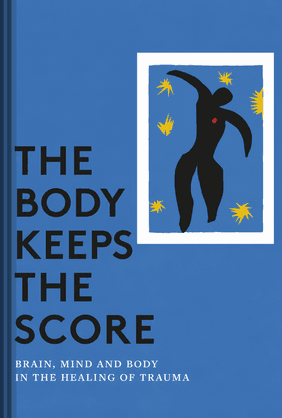
The Body Keeps The Score
Bessel Van Der Kolk
32 Duration10 Key Points4.5 RateNavigating Toxic Relationship Patterns
The pain body thrives in intimate relationships. In fact, romantic partnerships are the primary stage where the pain body feeds.
Often, you are drawn to a partner whose pain body perfectly complements yours. If your pain body plays the victim, you will likely attract a partner whose pain body plays the perpetrator. When one partner's pain body wakes up, it purposefully provokes the other partner to trigger theirs. Suddenly, two pain bodies are engaged in a vicious battle, feeding off the mutual anger and despair.
To break toxic relationship patterns:
- Recognize the switch: Acknowledge when your partner is no longer speaking to you, but their pain body is speaking. The tone of voice changes; their eyes may look cold or distant.
- Refuse to react: The moment you react defensively to a partner's pain body attack, yours awakens. Hold your presence. Stay completely silent and grounded.
- Do not point it out in the moment: Never tell a partner, "That is just your pain body." The ego will interpret this as a massive attack and escalate the conflict. Wait until both of you are calm and present before discussing the interaction.
When two pain bodies clash, intimate relationships often bear the brunt of the damage. If you frequently find yourself locked in repeating cycles of conflict with your partner, it is crucial to recognize how childhood wounds and unconscious emotional patterns dictate your romantic choices. Discovering the root causes of these mutual triggers can transform a battlefield of egos into a safe space for deep, conscious healing and mutual growth.

Getting the Love You Want
Harville Hendrix, Ph.D., Helen LaKelly Hunt, Ph.D.
23 Duration8 Key Points4.4 RateThe Long-Term Reality of Emotional Healing
Dissolving the pain body is not a weekend project. It is a lifelong practice of vigilance and presence.
Every time you catch your pain body waking up and you successfully observe it without letting it control your thoughts or actions, you chip away at its energy mass. It loses density. Over time, the emotional outbursts become less intense, less frequent, and shorter in duration.
Making this a lifelong practice can feel daunting, especially when you're too drained after work to sit down with a book.
Integrate this learning into your daily life by listening to 15-minute insights from transformative books during your commute or workout.
Download LeapAhead App now
You replace involuntary emotional reactivity with conscious response. You reclaim the driver's seat of your psychological life.
FAQ
Can the pain body ever be completely destroyed?
For most people, the pain body is never completely eradicated, but it is dramatically shrunk. Over time and with consistent practice of presence, it becomes a very weak energy field. It may still occasionally get triggered, but it will lack the power to hijack your mind or force you into destructive behaviors.
For most people, the pain body is never completely eradicated, but it is dramatically shrunk. Over time and with consistent practice of presence, it becomes a very weak energy field. It may still occasionally get triggered, but it will lack the power to hijack your mind or force you into destructive behaviors.
Is the pain body the same thing as psychological trauma?
Yes, they overlap significantly. What modern psychology refers to as complex trauma, PTSD, or emotional dysregulation resulting from childhood wounds, Tolle conceptualizes as the pain body. The psychological framework focuses on neural pathways and nervous system regulation, while Tolle’s framework offers a spiritual and philosophical mechanism for detaching from those same trauma responses.
Yes, they overlap significantly. What modern psychology refers to as complex trauma, PTSD, or emotional dysregulation resulting from childhood wounds, Tolle conceptualizes as the pain body. The psychological framework focuses on neural pathways and nervous system regulation, while Tolle’s framework offers a spiritual and philosophical mechanism for detaching from those same trauma responses.
Why do I feel physically exhausted after a pain body attack?
The pain body is an energy parasite. When it takes over, it forces your nervous system into an intense fight-or-flight state, burning massive amounts of adrenaline and cortisol. Once the episode passes and the pain body goes back to sleep, your physical body is left drained from the massive biochemical expenditure.
The pain body is an energy parasite. When it takes over, it forces your nervous system into an intense fight-or-flight state, burning massive amounts of adrenaline and cortisol. Once the episode passes and the pain body goes back to sleep, your physical body is left drained from the massive biochemical expenditure.
How do I handle my ego when it constantly judges my progress?
The voice criticizing your spiritual or emotional progress is simply the ego sneaking in through the back door. It loves to say, "You failed again, you let your triggers control you." Recognize that this judgment is just another egoic thought. Do not fight the judgment; just observe it and return your attention to the present moment.
The voice criticizing your spiritual or emotional progress is simply the ego sneaking in through the back door. It loves to say, "You failed again, you let your triggers control you." Recognize that this judgment is just another egoic thought. Do not fight the judgment; just observe it and return your attention to the present moment.