


You hit a wall at work, bomb a major presentation, or watch your team struggle to adapt to a new software system. Someone throws up their hands and says, "I'm just not wired for this." That single phrase exposes the hidden barrier holding them back. The limitation isn't their intelligence or their skillset. It is their fundamental belief about their own capabilities.
Understanding how to identify and shift these underlying beliefs is the most crucial step you can take to unlock human potential, whether you are managing a corporate team, guiding students, or pushing your own career forward.
The Foundation: Carol Dweck Mindset Theory
The conversation around how we view our own abilities stems from the Carol Dweck mindset theory. A renowned Stanford University psychologist, Dweck spent decades researching why some people fail while others succeed in identical situations. Her findings boiled down to a shockingly simple premise: our conscious and unconscious beliefs about intelligence profoundly affect our ability to learn.
Dweck discovered that people generally fall on a spectrum between two distinct cognitive frameworks: fixed and growth. These frameworks dictate how we handle stress, process feedback, and respond to failure.
For those who want a condensed overview of Dweck's research and the key distinctions she uncovered, a summary can provide a solid foundation.
Since the concepts in this article are rooted directly in Dr. Carol Dweck's groundbreaking psychological research, there is no better starting point than her original work. If you want to dive deeper into the science of how our beliefs shape our reality, Dweck's seminal book explores decades of hard data on high achievers. It is an essential read for anyone looking to permanently rewire their approach to success, parenting, and personal relationships.

Mindset
Carol S. Dweck
 51 Duration
 8 Key Points
 4.6 Rate
Reading foundational books like Dweck's is a powerful first step, but finding time for deep reading can be a challenge. For those who want to absorb these critical ideas on the go, an app can be a great starting point.


Grasp the key insights from 'Mindset' and other essential books on personal development in 15-minute summaries, making it easy to learn even on your busiest days.
 LeapAhead
Defining the Two Mindsets
To grasp the true growth mindset definition, you first have to understand what it is reacting against.
What is a Fixed Mindset?
In a fixed mindset, individuals believe their basic qualities—like intelligence, creativity, or athletic talent—are simply fixed traits. They believe they have a certain amount of capability, and that's that.
Because they believe potential is capped at birth, their primary goal becomes looking smart and avoiding failure at all costs. If you fail, it means you lack innate talent. This creates a constant need for validation. A fixed mindset tells you that if you have to work hard at something, you must not be good at it.
What is a Growth Mindset?
The core growth mindset definition revolves around the belief that your basic abilities can be cultivated through effort, good strategies, and input from others. People with this mindset do not believe everyone is the same or that anyone can become Albert Einstein. However, they do believe that everyone can get smarter and more capable if they put in the work.
This framework transforms the meaning of effort and difficulty. Effort is no longer a sign of weakness; it is the exact mechanism that creates mastery.

The Core Difference Between Fixed and Growth Mindset
To recognize these mindsets in the wild, you have to look at how people respond to specific triggers. The difference between fixed and growth mindset is most visible when things get difficult.
| Trigger | Fixed Mindset Response | Growth Mindset Response |
| :--- | :--- | :--- |
| Challenges | Avoids them to protect their ego and prevent looking foolish. | Embraces them as opportunities to expand their abilities. |
| Obstacles | Gives up easily; gets defensive when things don't go perfectly. | Persists through setbacks; views roadblocks as puzzles to solve. |
| Effort | Views effort as fruitless or a sign of low natural ability. | Sees effort as the necessary path to mastery and excellence. |
| Criticism | Ignores useful negative feedback or takes it as a personal attack. | Learns from criticism and uses it to recalibrate their approach. |
| Success of Others | Feels threatened, jealous, or diminished by others' achievements. | Finds inspiration and tactical lessons in the success of others. |
| :--- | :--- | :--- |
| Challenges | Avoids them to protect their ego and prevent looking foolish. | Embraces them as opportunities to expand their abilities. |
| Obstacles | Gives up easily; gets defensive when things don't go perfectly. | Persists through setbacks; views roadblocks as puzzles to solve. |
| Effort | Views effort as fruitless or a sign of low natural ability. | Sees effort as the necessary path to mastery and excellence. |
| Criticism | Ignores useful negative feedback or takes it as a personal attack. | Learns from criticism and uses it to recalibrate their approach. |
| Success of Others | Feels threatened, jealous, or diminished by others' achievements. | Finds inspiration and tactical lessons in the success of others. |
Seeing the two mindsets side-by-side makes the benefits of a growth-oriented framework clear. If you're ready to move from theory to practice, it's helpful to have a set of concrete strategies to follow.
Recognizing Fixed Mindset Examples in Real Life
You can spot a fixed mindset instantly by listening to how people explain their failures or limitations. Here are common fixed mindset examples across different environments, contrasted with how a growth mindset would reframe the exact same situation.
In the Workplace
An employee is passed over for a promotion in favor of a colleague.
- Fixed: "Management just plays favorites. I’m not a natural leader, and they know it. There’s no point in trying for the next opening."
- Growth: "I’m disappointed I didn't get the role. I need to schedule a meeting with my manager to understand exactly where my skill gaps are so I can develop them over the next six months."
In Education
A student scores a D on a mid-term calculus exam.
- Fixed: "I am just not a math person. My brain doesn't work this way."
- Growth: "My current study strategy for calculus isn't working. I need to visit the tutoring center, change how I organize my notes, and try practicing different problem sets."
This exact scenario plays out in classrooms across the country. The language teachers and parents use has a profound impact on a child's relationship with learning and challenge.
In Personal Development
Someone decides to get in shape and attempts to run a 5K, but has to stop and walk after the first mile.
- Fixed: "I don't have an athletic bone in my body. Running just isn't for me."
- Growth: "My endurance isn't there yet. I need to look up a beginner training plan online and start with run-walk intervals."

Shifting from a fixed to a growth mindset takes more than just recognizing the problem; it requires serious perseverance, especially when you encounter those inevitable setbacks. If you are looking for practical ways to build resilience and push through the "I'm just not good at this" barrier, understanding the psychology of passion and endurance is incredibly helpful. This next recommendation perfectly complements the growth mindset by explaining why long-term stamina often outshines raw, natural talent.

Grit
Angela Duckworth
18 Duration8 Key Points4.6 RateHow Leaders and Educators Can Drive a Growth Mindset
If you manage people—whether in a corporate office, a retail floor, or a classroom—your language shapes their mindset. You cannot just demand that someone adopt a growth mindset. You have to build an environment that rewards it.
1. Praise the Process, Not the Trait
This is the most common trap HR professionals and teachers fall into. When you tell someone, "You got an A, you are so smart," or "You closed that deal, you're a natural salesman," you are reinforcing a fixed mindset. You are telling them their success comes from an inherent trait. When they eventually fail, they will assume they lost that trait.
Instead, praise the strategy and the effort.
- Do say: "I loved how you tested three different marketing angles before launching the campaign. That thoroughness really paid off."
- Do say: "I noticed how much time you spent reviewing the material you struggled with last week. Your new study strategy is clearly working."
2. Destigmatize Failure
If your company culture punishes honest mistakes, your employees will hide their errors and avoid taking risks. They will default to a fixed mindset out of self-preservation. Create post-mortem meetings where teams analyze failed projects without pointing fingers. Ask questions like, "What did we learn from this data?" and "How does this change our approach for the next quarter?"
3. Harness the Power of "Yet"
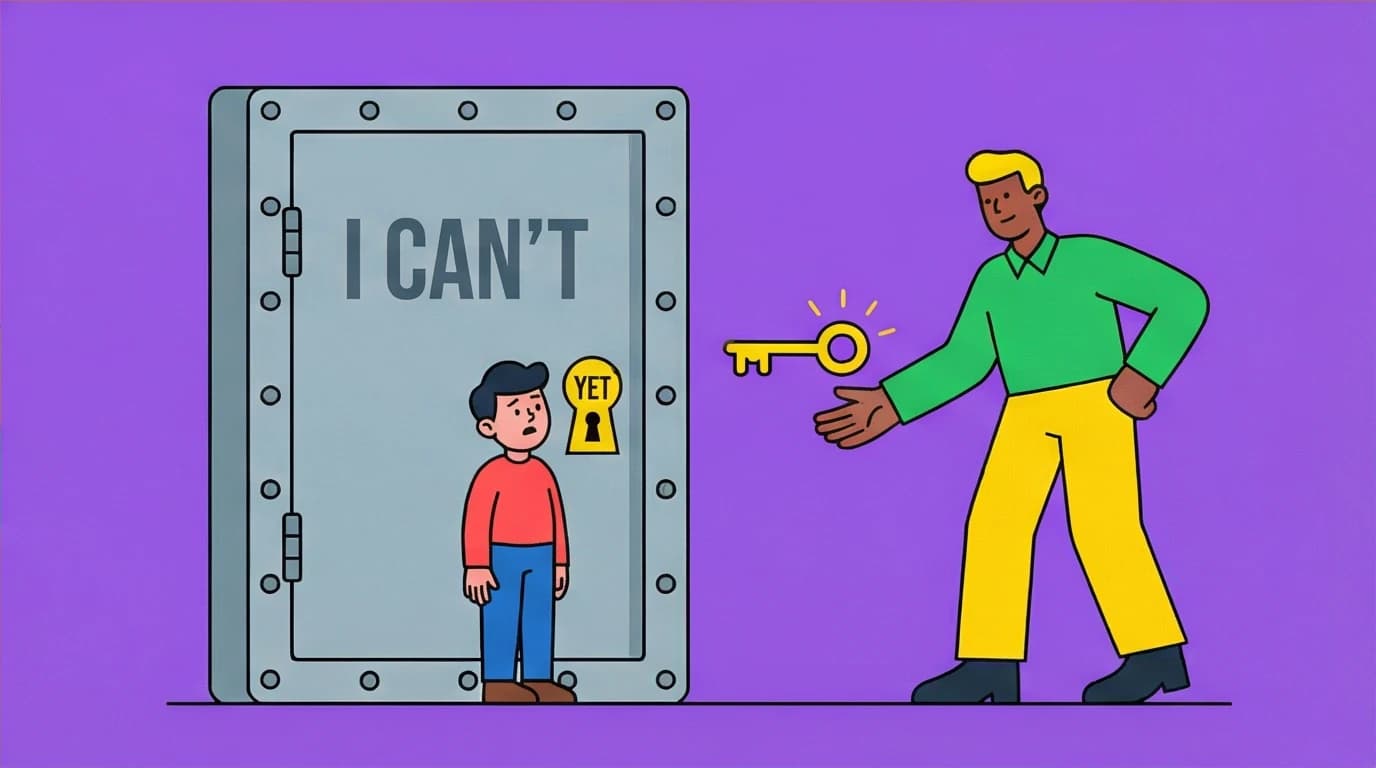
When an employee or student says, "I can't figure out this new CRM software," or "I don't understand this concept," train yourself to add one word to the end of their sentence: Yet.
"You don't understand it yet."
This tiny linguistic shift instantly moves the brain from a state of finality to a state of possibility.
"You don't understand it yet."
This tiny linguistic shift instantly moves the brain from a state of finality to a state of possibility.
As a leader, helping your team transition into a growth mindset often means tackling the deeply ingrained behaviors that made them successful in the past but are now holding them back. Top executives frequently get stuck in a fixed mindset because their previous strategies worked well enough. If you want to coach your employees (or yourself) through these stubborn behavioral blind spots and foster a culture of continuous development, this classic leadership guide offers phenomenal, actionable advice.

What Got You Here Won't Get You There
Marshall Goldsmith
15 Duration7 Key Points4.3 RateAvoiding the "False Growth Mindset"
As the concepts of fixed and growth mindsets became popular in corporate training and education, a dangerous mutation occurred: the False Growth Mindset.
Many people mistakenly believe that having a growth mindset just means being positive, open-minded, or praising sheer effort. It does not. Praising a student or an employee for trying hard—even when they repeatedly fail and refuse to change their strategy—is not a growth mindset. It is a participation trophy.
True growth mindset requires tying effort to actual progress. If someone is working hard but failing, the growth mindset response is to stop, analyze the failure, and try a completely different strategy. It is about actionable development, not blind optimism.
The "False Growth Mindset" often traps people into repeatedly trying the same failed strategies while expecting a different outcome. To break out of this cycle, you need the cognitive flexibility to question your own assumptions and willingly abandon tactics that no longer serve you. If you struggle to let go of old ideas or want to sharpen your ability to rethink problems from the ground up, this thought-provoking read will help you master the art of mental agility.

Think Again
Adam Grant
38 Duration8 Key Points4.6 RateBuilding a true growth mindset is an ongoing practice, not a one-time fix. If the idea of consistently learning from authors like Dweck, Duckworth, and Grant feels inspiring but your to-read list feels overwhelming, a book summary app can help you stay on track.
Turn your learning goals into a manageable daily habit by listening to the core ideas from thousands of nonfiction books on success and psychology during your commute or gym time.
LeapAheadFAQ
Can you have a growth mindset in one area and a fixed mindset in another?
Absolutely. Mindsets are rarely absolute. You might have a strong growth mindset regarding your professional skills (believing you can always learn new software or management techniques), but hold a strict fixed mindset about your personal life (believing you are inherently "bad at public speaking" or "terrible at relationships"). Recognizing these specific triggers is the first step to changing them.
Absolutely. Mindsets are rarely absolute. You might have a strong growth mindset regarding your professional skills (believing you can always learn new software or management techniques), but hold a strict fixed mindset about your personal life (believing you are inherently "bad at public speaking" or "terrible at relationships"). Recognizing these specific triggers is the first step to changing them.
How do I deal with an employee who has a deeply fixed mindset?
Start by lowering the stakes of failure. Employees with fixed mindsets are terrified of looking incompetent. Break their tasks down into smaller milestones where they can achieve quick wins. When they hit a roadblock, sit with them and ask, "What alternate strategies can we try here?" Shift their performance reviews from focusing solely on outcomes to also measuring their learning and adaptability.
Start by lowering the stakes of failure. Employees with fixed mindsets are terrified of looking incompetent. Break their tasks down into smaller milestones where they can achieve quick wins. When they hit a roadblock, sit with them and ask, "What alternate strategies can we try here?" Shift their performance reviews from focusing solely on outcomes to also measuring their learning and adaptability.
Is a fixed mindset ever helpful?
In practical terms, a fixed mindset is almost never helpful for long-term development. However, it does serve a psychological purpose: it acts as a defense mechanism. It protects the ego from the painful realization that you might need to work harder than others to achieve the same result. Understanding this helps you approach fixed-mindset individuals with empathy rather than frustration.
In practical terms, a fixed mindset is almost never helpful for long-term development. However, it does serve a psychological purpose: it acts as a defense mechanism. It protects the ego from the painful realization that you might need to work harder than others to achieve the same result. Understanding this helps you approach fixed-mindset individuals with empathy rather than frustration.