

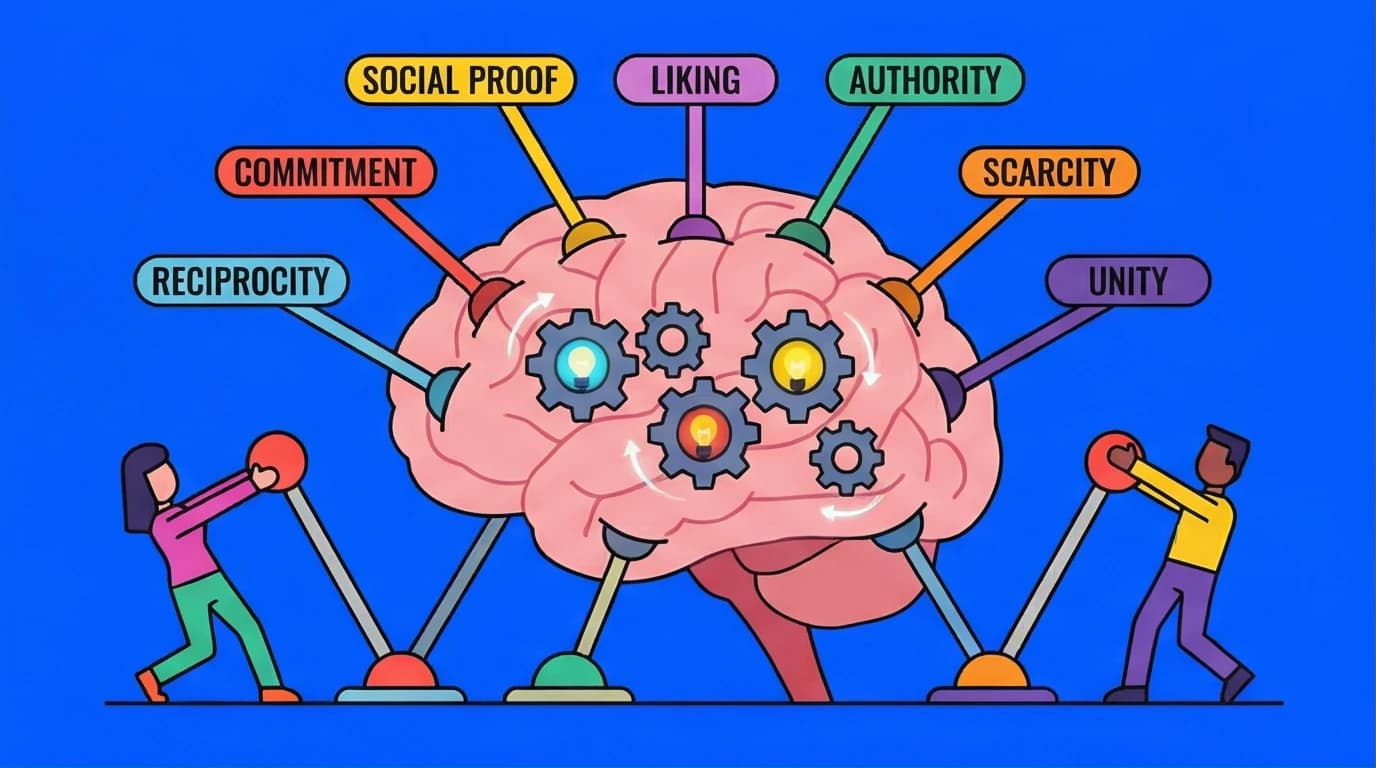
You have a product to sell, an idea to pitch, or a campaign to launch. You know human psychology dictates the outcome, but you lack the hours required to read a dense 300-page behavioral science book. You need the exact triggers that prompt human compliance, and you need them right now.
If finding time for foundational books like Influence is a constant challenge, it's worth exploring ways to absorb their core ideas more efficiently.


LeapAhead

Get the key insights from Cialdini's Influence and other essential business books in 15-minute audio or text summaries, perfect for learning on a tight schedule.
Consider this your psychology of persuasion cheat sheet.
Dr. Robert B. Cialdini spent years going undercover. He took jobs as a used car salesman, a telemarketer, and a fundraiser to see how compliance professionals get people to say "yes." What he found wasn't random magic. It was a structured set of automated, tape-run human behaviors.
When we encounter certain triggers, we stop thinking and start acting. While the original framework focused on the 6 principles of persuasion Cialdini made famous, his later work expanded this to include a critical seventh rule.
Here is the definitive influence robert cialdini summary, detailing exactly how these triggers work, how you can apply them in business, and how you can stop them from being used against you.
While this summary breaks down each principle, seeing them in action can truly clarify their power.
1. Reciprocity: The Give and Take Obligation
Humans are hardwired to return favors. If someone gives us something, we feel deeply obligated to pay them back. This social rule is so deeply embedded in our DNA that it often overrides our better judgment, making us say yes to people we don't even like just because they gave us a small gift first.
The Trigger: Someone provides a concession, a gift, or a favor. You instantly feel a psychological debt.
Real-World Example:
Walk into any Costco on a Saturday. You are offered a free slice of pizza or a small cup of premium juice. It feels like a simple sample, but it’s a highly effective compliance tactic. Once you take the free sample, the social pressure to buy a box of that product skyrockets. Non-profits use this too. The Disabled American Veterans organization found that mailing out simple appeal letters yielded an 18% response rate. When they included a small, unsolicited gift—customized return address labels—the success rate nearly doubled to 35%.
Walk into any Costco on a Saturday. You are offered a free slice of pizza or a small cup of premium juice. It feels like a simple sample, but it’s a highly effective compliance tactic. Once you take the free sample, the social pressure to buy a box of that product skyrockets. Non-profits use this too. The Disabled American Veterans organization found that mailing out simple appeal letters yielded an 18% response rate. When they included a small, unsolicited gift—customized return address labels—the success rate nearly doubled to 35%.
How to Apply It:
Always offer value first. In digital marketing, this means giving away a high-quality template, an exclusive ebook, or a free software audit before ever asking for a credit card. In negotiations, make a strategic concession early on. The other party will feel naturally pressured to concede something in return to maintain balance.
Always offer value first. In digital marketing, this means giving away a high-quality template, an exclusive ebook, or a free software audit before ever asking for a credit card. In negotiations, make a strategic concession early on. The other party will feel naturally pressured to concede something in return to maintain balance.
How to Defend:
Identify the initial favor for what it is: a compliance trick, not a genuine gift. Once you mentally reframe the "gift" as a sales tactic, the psychological burden to reciprocate completely disappears.
Identify the initial favor for what it is: a compliance trick, not a genuine gift. Once you mentally reframe the "gift" as a sales tactic, the psychological burden to reciprocate completely disappears.
Understanding the push and pull of reciprocity is an absolute game-changer in high-stakes negotiations. If you want to take your negotiation skills beyond basic marketing tactics and learn how to navigate complex, emotionally charged conversations, you might want to look into how top FBI hostage negotiators operate. Learning to use empathy, calibrated questions, and tactical concessions can give you an incredible edge in any business deal. For a masterclass in these advanced communication strategies, this highly acclaimed book is a must-read.
Never Split the Difference
Chris Voss, Tahl Raz
 41 Duration
 8 Key Points
 4.6 Rate
2. Commitment and Consistency: The Drive to Align
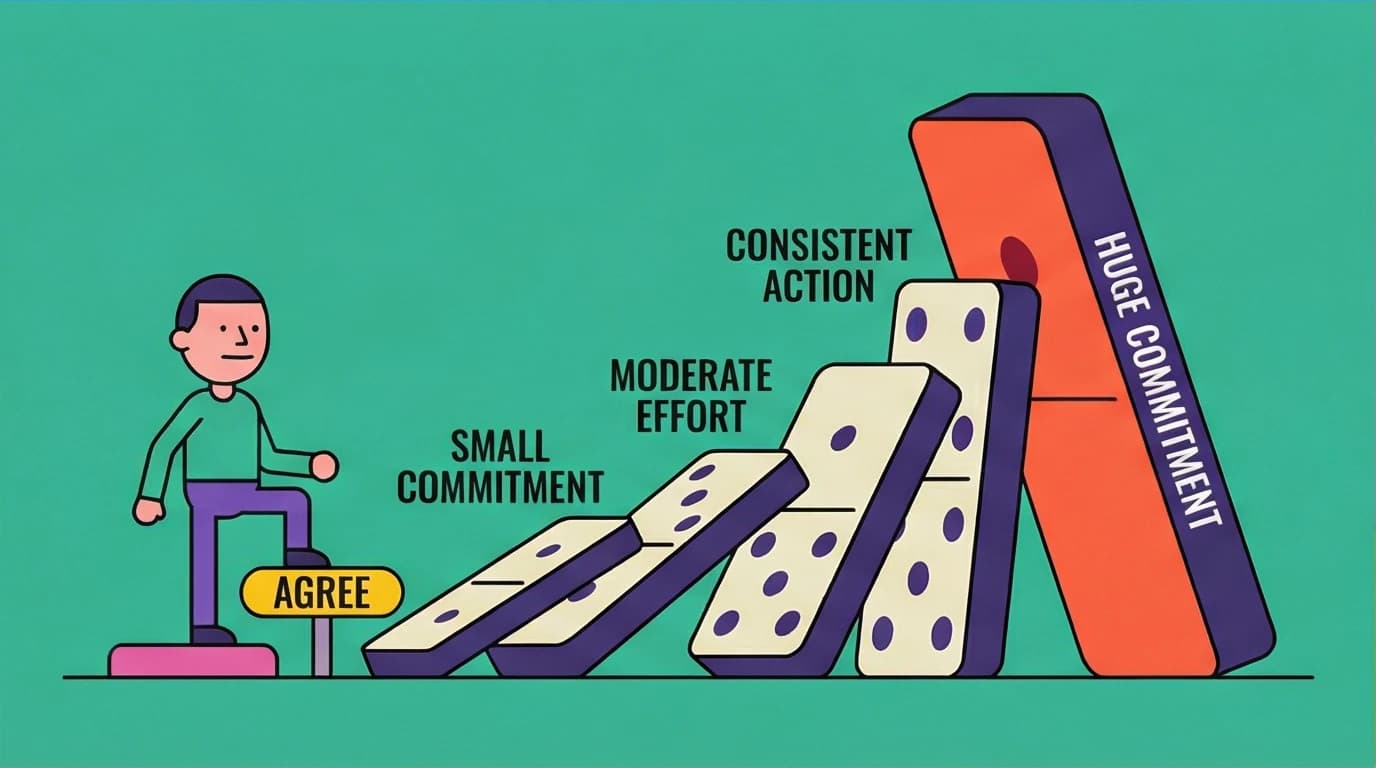
Once we make a choice or take a stand, we face personal and interpersonal pressures to behave consistently with that commitment. We want to appear stable and rational. Cialdini found that once someone takes a small step in a specific direction, they are vastly more likely to agree to much larger requests that align with that initial step.
The Trigger: A small, seemingly insignificant "yes" or a public declaration.
Real-World Example:
Researchers once asked homeowners in a California neighborhood to put a massive, ugly "Drive Carefully" billboard on their front lawns. Almost everyone refused. But in a different neighborhood, researchers first asked homeowners to put a tiny, three-inch "Be a Safe Driver" sticker in their windows. Two weeks later, they asked those same people to put up the giant billboard. A staggering 76% agreed. The small sticker shifted their self-identity. They became "citizens who care about safe driving."
Researchers once asked homeowners in a California neighborhood to put a massive, ugly "Drive Carefully" billboard on their front lawns. Almost everyone refused. But in a different neighborhood, researchers first asked homeowners to put a tiny, three-inch "Be a Safe Driver" sticker in their windows. Two weeks later, they asked those same people to put up the giant billboard. A staggering 76% agreed. The small sticker shifted their self-identity. They became "citizens who care about safe driving."
How to Apply It:
Get your audience to make a small, frictionless commitment. Instead of asking for a $100 donation right away, ask them to sign a free petition. Once they sign, their self-image aligns with your cause. In sales, get the prospect to publicly agree with your product's underlying philosophy before pitching the price.
Get your audience to make a small, frictionless commitment. Instead of asking for a $100 donation right away, ask them to sign a free petition. Once they sign, their self-image aligns with your cause. In sales, get the prospect to publicly agree with your product's underlying philosophy before pitching the price.
How to Defend:
Listen to your gut. If you feel trapped by a previous statement or a small action that is now snowballing into a major financial or time commitment, stop. You do not owe consistency to a manipulator.
Listen to your gut. If you feel trapped by a previous statement or a small action that is now snowballing into a major financial or time commitment, stop. You do not owe consistency to a manipulator.
3. Social Proof: Safety in Numbers
We view a behavior as more correct in a given situation to the degree that we see others performing it. When we are uncertain, we look outward. If everyone else is doing it, it must be the right thing to do.
The Trigger: Evidence that a large number of people—especially people similar to us—are taking a specific action.
Real-World Example:
Think about the last time you bought something on Amazon. If two products look identical, but one has 14 reviews and the other has 14,000 five-star reviews, you buy the latter without hesitation. Television executives use laugh tracks for the same reason; experiments show that canned laughter makes audiences rate jokes as funnier. Bartenders often "salt" their tip jars with a few dollar bills at the start of the night to signal that tipping is the expected behavior.
Think about the last time you bought something on Amazon. If two products look identical, but one has 14 reviews and the other has 14,000 five-star reviews, you buy the latter without hesitation. Television executives use laugh tracks for the same reason; experiments show that canned laughter makes audiences rate jokes as funnier. Bartenders often "salt" their tip jars with a few dollar bills at the start of the night to signal that tipping is the expected behavior.
How to Apply It:
Show, don't just tell. Display user counters ("Join 50,000 other subscribers"), showcase prominent case studies, and feature user-generated content. If you want a specific segment to convert, show them testimonials from people exactly like them. College students look to other college students; executives look to other executives.
Show, don't just tell. Display user counters ("Join 50,000 other subscribers"), showcase prominent case studies, and feature user-generated content. If you want a specific segment to convert, show them testimonials from people exactly like them. College students look to other college students; executives look to other executives.
How to Defend:
Recognize that the crowd is often wrong or artificially manufactured. Fake reviews, paid influencers, and staged long lines outside a club are engineered social proof. Disconnect the popularity of a product from its actual utility to you.
Recognize that the crowd is often wrong or artificially manufactured. Fake reviews, paid influencers, and staged long lines outside a club are engineered social proof. Disconnect the popularity of a product from its actual utility to you.
Our reliance on social proof is just one of many ways our brains bypass logical thinking in favor of mental shortcuts. Human beings constantly make baffling, illogical choices—from overpaying for a cup of coffee to procrastinating on important tasks—yet these irrational behaviors follow very predictable patterns. If you are fascinated by the hidden forces that shape our everyday decisions and want to understand why your customers often act against their own best interests, exploring the field of behavioral economics will completely change your perspective.

Predictably Irrational
Dan Ariely
23 Duration10 Key Points4.6 Rate4. Liking: The Friendly Thief
We prefer to say yes to the requests of someone we know and like. But compliance professionals know how to engineer this liking. We like people who are similar to us, people who pay us compliments, and people who cooperate with us toward mutual goals.
The Trigger: Physical attractiveness, similarity, compliments, or frequent pleasant contact.
Real-World Example:
The classic Tupperware party was built entirely on this principle. You weren't buying plastic containers from a faceless corporation; you were buying them from your friend, neighbor, or sister. The affection for the host overpowered the actual need for the product. Car salespeople are trained to look for clues in your car trade-in. If they see golf clubs in the trunk, they will casually mention their love for the sport to build immediate rapport.
The classic Tupperware party was built entirely on this principle. You weren't buying plastic containers from a faceless corporation; you were buying them from your friend, neighbor, or sister. The affection for the host overpowered the actual need for the product. Car salespeople are trained to look for clues in your car trade-in. If they see golf clubs in the trunk, they will casually mention their love for the sport to build immediate rapport.
How to Apply It:
Build genuine relationships before making your ask. Find shared interests, common backgrounds, or mutual frustrations. Use the "About Us" page on your website to humanize your brand. People buy from people, not logos. Ensure your customer service is exceptionally warm and empathetic.
Build genuine relationships before making your ask. Find shared interests, common backgrounds, or mutual frustrations. Use the "About Us" page on your website to humanize your brand. People buy from people, not logos. Ensure your customer service is exceptionally warm and empathetic.
How to Defend:
Mentally separate the salesperson from the product. If you find yourself liking a car salesperson immensely after just 20 minutes, a red flag should go up. Ask yourself: "Would I still buy this car at this price if I absolutely despised the person selling it?"
Mentally separate the salesperson from the product. If you find yourself liking a car salesperson immensely after just 20 minutes, a red flag should go up. Ask yourself: "Would I still buy this car at this price if I absolutely despised the person selling it?"
This ability to separate the messenger from the message is a core skill in protecting yourself from unwanted influence. From sales floors to social media, these persuasion techniques are constantly at play.
5. Authority: Directed Deference
Human beings are conditioned from birth to obey authority figures. We often comply with the mere symbols of authority—titles, clothing, and expensive possessions—without ever verifying the person's actual credentials.
The Trigger: Uniforms, academic titles (Dr., Prof.), industry awards, or authoritative tones.
Real-World Example:
In the infamous Milgram experiment, volunteers were willing to deliver what they believed were lethal electrical shocks to another person simply because a man in a white lab coat told them to continue. In marketing, we see this constantly. Toothpaste commercials feature actors in white lab coats holding clipboards. The actor isn't a dentist, but the visual cue of authority bypasses our critical thinking.
In the infamous Milgram experiment, volunteers were willing to deliver what they believed were lethal electrical shocks to another person simply because a man in a white lab coat told them to continue. In marketing, we see this constantly. Toothpaste commercials feature actors in white lab coats holding clipboards. The actor isn't a dentist, but the visual cue of authority bypasses our critical thinking.
How to Apply It:
Don't hide your expertise. Display your credentials, awards, and years of experience prominently. If you are citing data, borrow authority by citing highly respected institutions like Harvard, MIT, or the Mayo Clinic. Dress appropriately for the role you want to project; a sharp suit or a specialized uniform immediately shifts how people perceive your demands.
Don't hide your expertise. Display your credentials, awards, and years of experience prominently. If you are citing data, borrow authority by citing highly respected institutions like Harvard, MIT, or the Mayo Clinic. Dress appropriately for the role you want to project; a sharp suit or a specialized uniform immediately shifts how people perceive your demands.
How to Defend:
Ask two questions. First, "Is this authority truly an expert?" (An actor in a lab coat is not a doctor). Second, "How truthful can we expect this expert to be here?" (Even a real doctor might be getting paid to endorse a specific vitamin).
Ask two questions. First, "Is this authority truly an expert?" (An actor in a lab coat is not a doctor). Second, "How truthful can we expect this expert to be here?" (Even a real doctor might be getting paid to endorse a specific vitamin).
6. Scarcity: The Rule of the Few
Opportunities seem more valuable to us when their availability is limited. The idea of potential loss plays a massive role in human decision-making. We are vastly more motivated by the thought of losing something than by the thought of gaining something of equal value.
The Trigger: Limited time, limited supply, or exclusive access.
Real-World Example:
Airline websites are masters of scarcity. When you search for a flight from New York to Chicago, you invariably see a red tag stating, "Only 2 seats left at this price!" The fear of missing out (FOMO) kicks in, and you book immediately. Similarly, "Black Friday" relies entirely on time-bound scarcity to drive billions of dollars in sales within a 24-hour window.
Airline websites are masters of scarcity. When you search for a flight from New York to Chicago, you invariably see a red tag stating, "Only 2 seats left at this price!" The fear of missing out (FOMO) kicks in, and you book immediately. Similarly, "Black Friday" relies entirely on time-bound scarcity to drive billions of dollars in sales within a 24-hour window.
How to Apply It:
Communicate what your audience stands to lose if they don't act. Use authentic countdown timers on your sales pages. Release limited-edition products. Offer early-bird pricing that expires on a specific date. However, the scarcity must be real. If you run a "closing down sale" that lasts for three years, customers will realize the facade and your credibility will tank.
Communicate what your audience stands to lose if they don't act. Use authentic countdown timers on your sales pages. Release limited-edition products. Offer early-bird pricing that expires on a specific date. However, the scarcity must be real. If you run a "closing down sale" that lasts for three years, customers will realize the facade and your credibility will tank.
How to Defend:
Separate the joy of owning the item from the thrill of beating the crowd. Scarcity makes us act impulsively, but it does not make the product taste better, perform faster, or last longer. When you feel the panic of scarcity setting in, step away for 24 hours.
Separate the joy of owning the item from the thrill of beating the crowd. Scarcity makes us act impulsively, but it does not make the product taste better, perform faster, or last longer. When you feel the panic of scarcity setting in, step away for 24 hours.
While scarcity can drive an immediate spike in sales, the most effective organizations look at the bigger picture of how choices are presented. By subtly altering the environment where people make decisions—often called "choice architecture"—you can ethically guide them toward better outcomes without restricting their freedom. Whether you are designing a new employee benefits program, restructuring your e-commerce checkout flow, or just trying to help your team make smarter daily choices, understanding how to effectively steer behavior is an invaluable skill.

Nudge
Richard H. Thaler, Cass R. Sunstein
45 Duration8 Key Points4.6 Rate
The Missing Piece: Understanding Cialdini 7 Principles
For decades, marketers swore by the original six rules. However, human behavior is complex, and Cialdini later realized a massive driver of influence was missing from the initial edition of his book. When you look up the complete framework today, you are looking at the Cialdini 7 principles. The seventh is Unity.
7. Unity: The "We" Factor
Unity is about shared identity. It goes beyond mere similarity (which falls under Liking) and touches on a deeper sense of belonging. When we perceive someone as being "one of us," we are incredibly susceptible to their influence. It is the concept of the tribe.
The Trigger: Shared bloodlines, geographic roots, deep religious or political affiliations, or intense shared experiences.
Real-World Example:
Warren Buffett used this perfectly in a famous letter to Berkshire Hathaway shareholders. When advising on what investors should do, he wrote, "I will tell you what I have told my own family." By invoking family, Buffett pulled his shareholders into a tight circle of trust. We don't question advice meant for family members. Sports fanbases and military units also heavily leverage unity; members will buy specific gear, defend their group fiercely, and follow leaders without hesitation simply because they wear the same team colors.
Warren Buffett used this perfectly in a famous letter to Berkshire Hathaway shareholders. When advising on what investors should do, he wrote, "I will tell you what I have told my own family." By invoking family, Buffett pulled his shareholders into a tight circle of trust. We don't question advice meant for family members. Sports fanbases and military units also heavily leverage unity; members will buy specific gear, defend their group fiercely, and follow leaders without hesitation simply because they wear the same team colors.
How to Apply It:
Co-create with your audience. Use language that emphasizes a shared journey or an exclusive community. If you target local businesses, emphasize your shared local roots ("As a fellow Texan..."). Ask for advice rather than feedback; asking for advice puts you and the customer in a collaborative "we" state of mind.
Co-create with your audience. Use language that emphasizes a shared journey or an exclusive community. If you target local businesses, emphasize your shared local roots ("As a fellow Texan..."). Ask for advice rather than feedback; asking for advice puts you and the customer in a collaborative "we" state of mind.
How to Defend:
Tribalism blinds us. When someone invokes "us versus them" to get you to buy a product or support a movement, take a step back. Evaluate the request on its actual merits, completely detached from the identity politics or tribal loyalty being manipulated.
Tribalism blinds us. When someone invokes "us versus them" to get you to buy a product or support a movement, take a step back. Evaluate the request on its actual merits, completely detached from the identity politics or tribal loyalty being manipulated.
Understanding these seven principles is foundational, but applying them ethically and effectively in a modern business context is the next step.
Summary: Moving From Theory to Action
Mastering the psychology behind human decisions does not require you to manipulate people. The most effective users of these principles act as sleuths, not smugglers. They don't invent fake scarcity or manufacture fake authority. Instead, they uncover the genuine authority, natural scarcity, and real social proof that already exists within their offer, and they highlight it.
Whether you are referencing the classic 6 principles of persuasion Cialdini mapped out decades ago, or utilizing the full Cialdini 7 principles modern marketers rely on today, the goal remains the same. You are smoothing the path to "yes" by speaking the psychological language the human brain is hardwired to understand.
While this cheat sheet provides a powerful overview of the core compliance triggers, nothing compares to exploring the primary source material. Dr. Cialdini’s comprehensive research is packed with fascinating historical examples, deep psychological studies, and nuanced applications that a short summary simply cannot capture. If you want to truly master the art of persuasion, build bulletproof marketing campaigns, and defend yourself against subtle manipulation tactics, reading the complete, unbridled text is one of the best investments you can make in your career.
Influence
Robert Cialdini, Ph.D.
50 Duration9 Key Points4.5 RateAnd if your to-read pile now feels a bit daunting, remember that understanding the core ideas is the first and most important step.
LeapAhead
Quickly digest the main arguments from all the books mentioned here, turning your new reading list from a chore into an achievable daily habit.
FAQ
What is the difference between the 6 and 7 principles of persuasion?
The original book, published in 1984, introduced six core principles: Reciprocity, Commitment, Social Proof, Authority, Liking, and Scarcity. In 2016, Cialdini released an updated version of his research where he added a seventh principle: Unity. Unity focuses on shared identity and the deep psychological impact of tribalism and belonging.
Is Cialdini's "Influence" still relevant in the digital age?
Absolutely. While the mediums have changed from door-to-door salesmen to Instagram ads and TikTok influencers, the underlying human psychology remains identical. Elements like Amazon reviews (Social Proof), countdown timers on checkout pages (Scarcity), and free software trials (Reciprocity) are direct digital applications of his original research.
How can I use these persuasion principles ethically?
The key to ethical influence is honesty. Do not manufacture fake countdown timers (false scarcity) or buy fake followers (false social proof). Instead, highlight the genuine value of your product using the principles as a framework to communicate more clearly. Use them to help people make decisions that genuinely benefit them, rather than tricking them into choices they will later regret.