

You stare at the blinking cursor on your screen, waiting for inspiration to strike. Another hour passes, and the page remains completely blank. Procrastination, self-doubt, and the myth of the perfect workspace kill more manuscripts than a lack of talent ever could.
If you want to stop making excuses and actually finish your work, you need a system that does not rely on motivation. You need a method forged by someone who treated output as an absolute necessity. Louis L'Amour wrote over 100 novels, sold hundreds of millions of copies, and remains a fixture on the shelves of Barnes & Noble and Amazon today. He did not achieve this by waiting for the muse. He achieved this through a brutal, uncompromising system.
This relentless drive was a product of a life spent in constant motion and self-directed learning, a journey he chronicled in his own memoir.

Here is exactly how you can strip away the romantic myths of creation and adopt the Louis L'Amour writing routine to dramatically increase your output.
The Blue-Collar Mindset Behind Louis L'Amour Writing Habits
Most modern creators view writing as an art form that requires the perfect alignment of mood, lighting, and caffeine. L'Amour viewed writing as a trade. Before he was a bestselling author, he was a longshoreman, a lumberjack, an elephant handler, and a boxer. When a lumberjack goes to work, he does not sit on a stump waiting to feel "inspired" to chop down a tree. He simply swings the ax.
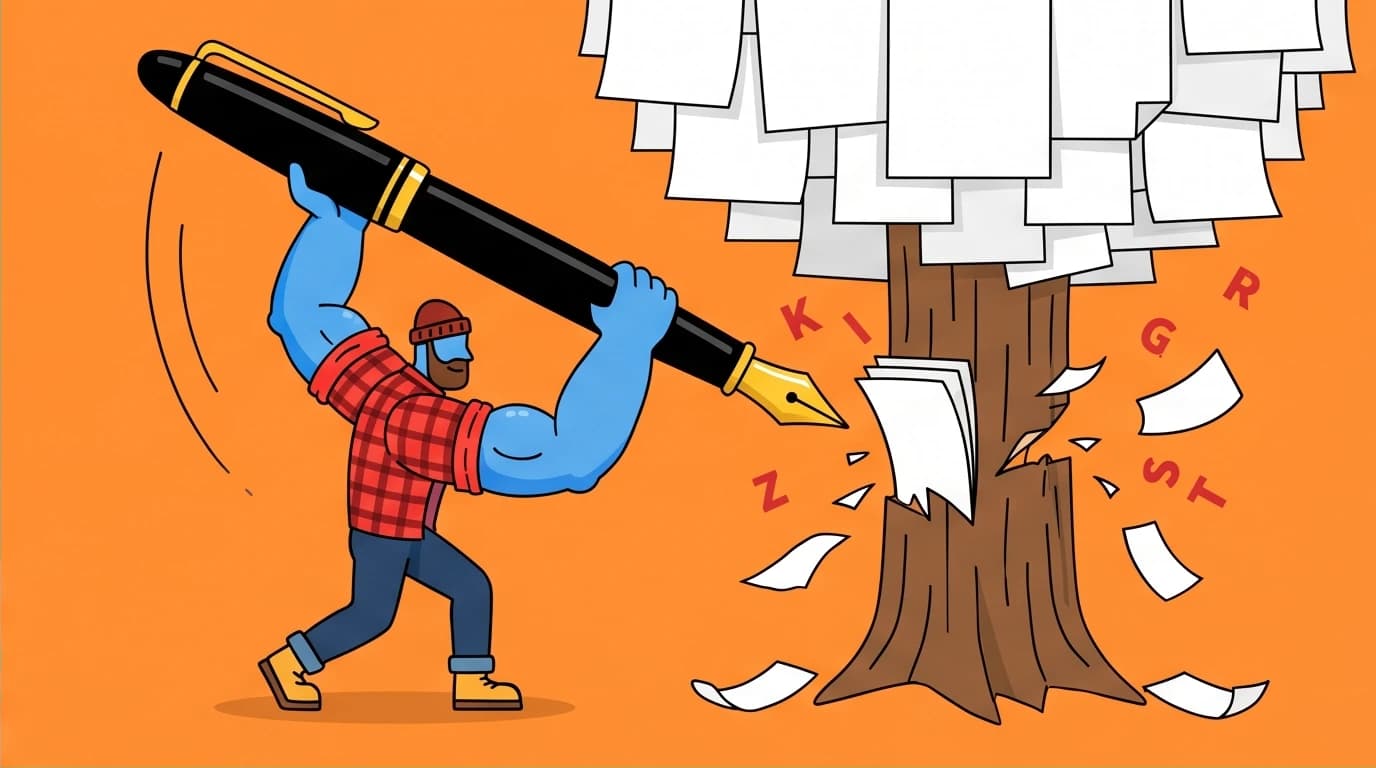
L'Amour carried this exact mindset to his typewriter. He famously stated that water does not flow until the faucet is turned on. You cannot edit a blank page.
To adopt Louis L'Amour writing habits, you must completely discard the idea that writing requires a special emotional state. You must stop treating your writing sessions like delicate artistic endeavors and start treating them like a 9-to-5 factory shift. You punch in, you move the raw material (words) onto the assembly line (the page), and you punch out.
This rugged, self-reliant mindset wasn't just about the act of writing; it was a core part of his entire worldview, shaping the resilient characters and harsh landscapes in his novels.
If this blue-collar, no-nonsense approach to the craft resonates with you, you will find a similar philosophy in Stephen King’s quintessential memoir on the writing life. King, much like L'Amour, famously approaches his daily word counts with the discipline of a factory worker. His insights on treating writing as a job rather than a fleeting magical state are invaluable for any aspiring author looking to build a sustainable, lifelong career without relying on unpredictable bursts of inspiration.

On Writing
Stephen King
 42 Duration
 8 Key Points
 4.5 Rate
Deconstructing the Routine: Core Principles of Execution
L'Amour’s daily execution can be broken down into three uncompromising principles. These are not gentle suggestions. They are the structural pillars of true creative discipline.
The Faucet Principle: Force the First Words
L'Amour never suffered from writer's block because he refused to acknowledge its existence. He believed that the physical act of typing would eventually trigger the mental state of creativity.
When you sit down, your brain will flood you with reasons to delay. You will want to check your phone, read an article, or organize your desk. Ignore it. Put your hands on the keyboard and force yourself to write a sentence. It does not matter if the sentence is garbage. It does not matter if you delete it later. The goal is to break the static friction. Once the water starts flowing, it clears the rust out of the pipes, and eventually, the clear water of good ideas follows.
That overwhelming urge to check your phone or organize your desk when you first sit down is what Steven Pressfield famously labels as "Resistance." If you find yourself constantly losing the battle against these self-sabotaging delays, Pressfield’s tough-love manifesto is a must-read. It offers a brilliant, uncompromising breakdown of why we procrastinate and provides the mental framework you need to push through that initial friction, silence your inner critic, and finally put your ideas into the world.
The War of Art
Steven Pressfield
37 Duration9 Key Points4.5 RateThe "Busy Intersection" Rule
Modern writers spend a small fortune on noise-canceling headphones, aesthetic mechanical keyboards, and private office spaces. They convince themselves they cannot write unless conditions are optimal.
L'Amour once said he could write a book sitting in the middle of a busy intersection. He proved this throughout his life, writing on sinking merchant ships, in military camps during World War II, and at cramped kitchen tables.
Your environment is an excuse. If you demand perfect silence and a $2,000 MacBook to write a single paragraph, you lack resilience. You must train yourself to focus in less-than-ideal conditions.

Momentum Over Perfection
Prolific author habits share one universal trait: a relentless forward momentum during the drafting phase. L'Amour did not stop every three sentences to rewrite a paragraph, agonize over a specific adjective, or consult a thesaurus.
He wrote to find out what happened next. If he made a mistake, he kept going and fixed it later. Constant self-editing during the first draft is the equivalent of driving a car with the parking brake engaged. You will burn out your engine and cover very few miles.
Extracting Productivity Lessons From Authors for the Modern Creator
Translating a 1970s typewriter routine to a modern digital workflow requires a few strategic adjustments. When L'Amour sat down at his typewriter, it only did one thing: put ink on paper. When you sit down at your laptop, you are staring at a machine engineered to distract you with a billion different stimuli.
To successfully apply these productivity lessons from authors of the pre-internet era, you must artificially recreate their limitations.
Disconnect the Lifeline
Your Wi-Fi connection is the enemy of your word count. If you are writing a draft, you do not need the internet. If you encounter a fact you need to check—like the exact temperature in Fahrenheit water boils at an altitude of 5,000 feet—do not open a browser. Put a bracketed note like
[CHECK FACT] in your text and keep moving. Batch your research for a separate session.Box Your Time, Not Your Word Count
While some authors set strict word count goals, L'Amour often focused on the sheer discipline of sitting in the chair for a designated period. Set a timer for 90 minutes. During those 90 minutes, you are only allowed to do two things: write, or stare at the screen. You cannot look at your phone, you cannot go to the kitchen, and you cannot check emails. Make the alternative to writing so incredibly boring that your brain chooses to write just for entertainment.
Creating this kind of distraction-free environment is easier said than done in a world engineered to steal your attention. To master the art of timeboxing and truly reclaim your focus from pings and notifications, Nir Eyal’s research is a fantastic resource. He dives deep into the psychology of why we get distracted and shares highly actionable, tech-focused strategies to help you lock in on your creative sessions—ensuring that when you sit down to write, you actually write.
Indistractable
Nir Eyal
23 Duration10 Key Points4.5 RateBuilding Your Own Unbreakable Creative Discipline
Motivation is unreliable. It spikes after you watch an inspiring video or read a good book, and it vanishes the moment the work gets hard. Creative discipline is the system you rely on when motivation abandons you. Here is the exact framework to build it.
1. Establish a Non-Negotiable Trigger
Habits require triggers. Choose a specific time of day or a specific action that signals the start of your writing shift. It could be making a cup of black coffee at 6:00 AM, or sitting at a specific desk at 8:00 PM after the kids are asleep. Do this exact sequence every single day. Over time, this physical ritual will automatically trigger a psychological shift into work mode.
2. Set a Brutally Low Floor
If you set a goal to write 3,000 words a day, you will fail, get discouraged, and quit. Set a floor so low you cannot possibly fail. Commit to writing one single page every day. On days when you feel terrible, sick, or exhausted, force out that one page to keep the chain unbroken. On days when you feel good, that one page will effortlessly turn into ten.
The strategy of setting ridiculously small, fail-proof goals is a core pillar of modern habit-building science. If you want a comprehensive playbook on how these tiny, marginal improvements compound into massive creative output over time, James Clear’s work is essential. He breaks down exactly how to construct systems that work on your worst days, ensuring that your writing routine becomes an automatic, unbreakable part of your daily life regardless of your fluctuating motivation levels.

Atomic Habits
James Clear
26 Duration8 Key Points4.7 RateAbsorbing the wisdom from books like these is crucial, but finding the time to read them cover-to-cover can feel like another task on your to-do list.


Get the core ideas from bestselling books on discipline and creativity in just 15-minute audio or text sessions, so you can learn while commuting or taking a break from writing.
 LeapAhead
3. Divorce Your Self-Worth from the First Draft
The primary reason writers procrastinate is fear. They are terrified that what they put on the page will be bad. Accept right now that your first draft will be terrible. L'Amour understood that a writer's job is not to produce a masterpiece on the first try; it is to produce raw material. Give yourself permission to write absolute garbage. You are just shoveling sand into a box so you can build a castle later.

Common Pitfalls That Destroy Output
Even with the best intentions, it is easy to slip back into destructive habits. Watch out for these fatal errors.
The Research Trap
Research is a highly effective form of procrastination disguised as work. You do not need to read three books about the history of the railroad before you write a scene set on a train. Write the scene using your imagination, and fix the historical inaccuracies during the editing phase.
Research is a highly effective form of procrastination disguised as work. You do not need to read three books about the history of the railroad before you write a scene set on a train. Write the scene using your imagination, and fix the historical inaccuracies during the editing phase.
This isn't to say L'Amour neglected accuracy; rather, he compartmentalized it. His approach to fact-checking and historical details was as disciplined as his writing, but it had its own distinct place in his workflow.
Waiting for the "Big Block of Time"
You will rarely have a free, uninterrupted eight-hour block to write. If you wait for the weekend, or for a vacation, or for retirement, your book will never get written. Use the scraps of time. A 20-minute train commute, a 30-minute lunch break, or the 15 minutes before bed. Five pages a week is 260 pages a year—that is an entire novel built purely from stolen moments.
You will rarely have a free, uninterrupted eight-hour block to write. If you wait for the weekend, or for a vacation, or for retirement, your book will never get written. Use the scraps of time. A 20-minute train commute, a 30-minute lunch break, or the 15 minutes before bed. Five pages a week is 260 pages a year—that is an entire novel built purely from stolen moments.
If you want to fill those stolen moments with new ideas to fuel your writing, there are ways to learn without needing a physical book on hand.
This app is designed for these exact moments, letting you listen to key insights from bestselling nonfiction books during your commute, lunch break, or workout in 15-minute sessions.
LeapAheadTalking About Writing Instead of Writing
Do not post on social media about how hard your writing session is. Do not spend hours in online forums discussing the best outlining software. The energy you spend talking about your project is energy stolen directly from the execution of the project. Shut your mouth, sit in the chair, and do the work.
Do not post on social media about how hard your writing session is. Do not spend hours in online forums discussing the best outlining software. The energy you spend talking about your project is energy stolen directly from the execution of the project. Shut your mouth, sit in the chair, and do the work.
FAQ
Did Louis L'Amour outline his books?
Generally, no. L'Amour was what modern writers call a "pantser" or a discovery writer. He usually started with a strong character, a specific setting, and a conflict, and then let the story unfold organically on the page. He trusted his momentum to carry him to the end of the narrative.
Generally, no. L'Amour was what modern writers call a "pantser" or a discovery writer. He usually started with a strong character, a specific setting, and a conflict, and then let the story unfold organically on the page. He trusted his momentum to carry him to the end of the narrative.
How many words a day did Louis L'Amour write?
While his exact word counts fluctuated, he consistently produced around 5 to 10 pages a day, every day, without fail. This relentless daily consistency allowed him to finish draft after draft, often writing multiple complete novels in a single year.
While his exact word counts fluctuated, he consistently produced around 5 to 10 pages a day, every day, without fail. This relentless daily consistency allowed him to finish draft after draft, often writing multiple complete novels in a single year.
Can I apply this routine if I work a demanding full-time job?
Absolutely. L'Amour developed his work ethic while working grueling physical jobs around the world. The core of his routine is not about having unlimited free time; it is about fiercely protecting the small windows of time you do have and refusing to make excuses about your environment.
Absolutely. L'Amour developed his work ethic while working grueling physical jobs around the world. The core of his routine is not about having unlimited free time; it is about fiercely protecting the small windows of time you do have and refusing to make excuses about your environment.
What if the writing is terrible when I force it?
A terrible page can be edited, refined, and polished into a great page. A blank page remains a blank page forever. The purpose of forcing the words is to generate the raw material. Leave the critical judgment for your second draft.
A terrible page can be edited, refined, and polished into a great page. A blank page remains a blank page forever. The purpose of forcing the words is to generate the raw material. Leave the critical judgment for your second draft.