


Your third-grader leaves their science project on the kitchen counter. You spot it just as you pour your morning coffee. Do you grab the keys, drive to the school, and drop it off at the front office? Or do you leave it there and let them face the natural consequence of a zero?
This is the everyday tightrope walk of modern parenting. We want our children to be happy. We hate seeing them struggle, cry over a lost Little League game, or stress over middle school peer pressure. But swooping in to fix every problem robs them of the exact experiences they need to grow. Building resilience in children is not about making them immune to sadness or stress. It is about giving them the tools to process those feelings, get back up, and try again.
Here is a practical, stage-by-stage guide to shifting your approach and helping your child develop lasting mental strength.
The Foundation of Resilient Parenting
Resilient parenting requires a fundamental mindset shift. You are moving from the role of a "fixer" to the role of a "coach." A fixer runs onto the field to play the game for the child. A coach stands on the sidelines, offers guidance, cheers them on, and lets the child face the opposing team.

When we constantly clear the path for our children, we accidentally send a damaging message: I have to do this for you because you are not capable of doing it yourself. Over time, this breeds anxiety. Children who never experience failure grow into teenagers who are terrified of it. They lack the empirical evidence that they can survive a setback.
True resilience is built on two pillars: empathy and boundaries. You must deeply empathize with your child's frustration while maintaining the boundary that they must solve the problem themselves.
Before diving into specific techniques for children, it's helpful to understand the core concept you're aiming to cultivate. Grasping the psychological definition of resilience can provide a solid foundation for your parenting strategy.
Core Strategies for Building Resilience in Children
You cannot lecture a child into being resilient. They have to practice it. Here are the everyday habits you can adopt to foster independence.
1. Stop Rescuing Them from Safe Failures
A "safe failure" is any setback where the consequences are temporary and educational, rather than physically dangerous or permanently life-altering. Forgetting homework, getting a C on a math test, or having a disagreement with a friend are safe failures.
When your child hits a roadblock, pause. Take a breath. Ask yourself: What will happen if I do nothing? If the answer is simply that your child will be uncomfortable, embarrassed, or frustrated—let it happen. Experience is a far better teacher than a parent's warning.

2. Validate the Emotion, Delay the Solution
When a child is upset, their brain's emotional center takes over, shutting down the logical problem-solving center. If you immediately jump to offering solutions ("Just tell your teacher you forgot it," or "We can build another Lego tower"), they will reject the help.
First, validate the feeling. "I see how frustrated you are that your tower fell. You worked really hard on that." Once they feel heard, their nervous system calms down. Only then can you ask, "What do you think we should do next?"
To truly understand how your child's developing brain handles big emotions, you might want to dive deeper into the science behind these meltdowns. When you grasp how the "upstairs" and "downstairs" parts of their brain interact, it becomes much easier to respond with patience instead of frustration. If you are looking for practical, science-backed strategies to help your kids process their feelings and build emotional intelligence, this next book is an absolute must-read for your parenting toolkit.

The Whole-Brain Child
Daniel J. Siegel, M.D., Tina Payne Bryson, Ph.D.
 41 Duration
 7 Key Points
 4.6 Rate
3. Praise the Process, Not the Person
Focus your praise on effort, strategy, and perseverance rather than fixed traits.
- Instead of: "You're so smart! You got an A!"
- Say: "I noticed how hard you studied for that spelling bee. All those practice hours really paid off."
This teaches children that success comes from things they can control (their effort) rather than things they cannot (innate intelligence). When they eventually fail, they will view it as a lack of effort or a flawed strategy—both of which they can fix—rather than a personal defect.
This fundamental shift from praising innate intelligence to praising effort is rooted in decades of psychological research. By teaching your kids that their abilities can be developed through hard work and dedication, you are equipping them to bounce back from academic and personal setbacks. For parents wanting to fully embrace this approach and help their children cultivate a lifelong love of learning, exploring the foundational work on the "growth mindset" is incredibly eye-opening.

Mindset
Carol S. Dweck
51 Duration8 Key Points4.6 RateAge-Appropriate Activities to Build Resilience in Youth
Resilience looks different at age four than it does at age fourteen. You need to provide structured challenges that match their developmental stage. Here are targeted activities to build resilience in youth across different age groups.

For Toddlers and Preschoolers (Ages 2-5)
At this age, resilience is physical and highly immediate. It is about trying, falling down, and trying again.
- The Amazon Box Challenge: Give them empty cardboard boxes, pillows, and blankets, and let them build things. They will collapse. Your child might cry. Comfort them, but do not rebuild it for them. Encourage them to try a different way.
- Wait Time: Do not immediately drop what you are doing the second they whine for a snack. Say, "I am finishing these dishes, and then I will get your goldfish crackers." Learning to tolerate mild frustration builds emotional stamina.
- Playground Independence: When they trip on the playground and scrape a knee, wait three seconds before reacting. Often, kids look to parents to know how to react. If you gasp and look terrified, they will wail. If you smile calmly and say, "Whoops! Brush off that dirt, you're okay," they will often just keep playing.
For Elementary Kids (Ages 6-11)
School-age kids are developing social awareness and facing external evaluations (grades, sports).
- Board Games with No Mercy: Play games like Monopoly, Uno, or Connect 4. Do not let them win on purpose. Losing a board game in the safety of their own living room is excellent practice for losing in the real world. Teach them how to congratulate the winner gracefully.
- Household Contributions: Assign chores that actually matter. If their job is to feed the dog, and they forget, the dog goes hungry until they remember. (Obviously, do not let the dog starve, but wait until the child notices the empty bowl and guide them to fix it). Chores teach responsibility and consequence.
- The "Three Before Me" Rule: When they ask you for help with a math problem or a household task, tell them they must try three different ways to solve it themselves before you will step in.
For Teens (Ages 12+)
Teenagers face high stakes: driving, dating, college applications, and intense peer pressure. Your role transitions strictly to consulting.
- Advocating for Themselves: If your teen believes a teacher graded a paper unfairly, do not email the teacher. Sit down with your teen and help them draft an email or rehearse what they will say in person. They must hit the "Send" button.
- Outdoor Challenges: Physical challenges translate directly to mental toughness. Encourage activities like hiking a tough three-mile trail in the summer heat, camping, or learning a difficult sport. Managing physical discomfort in nature builds massive grit.
- Managing Their Own Budget: Give them a set allowance for discretionary spending (video games, fast food, movies). When they blow their monthly budget by the second week, do not give them an advance. Let them sit out the weekend trip to the mall with friends. They will learn resource management quickly.
Navigating the teenage years can be terrifying for parents, especially when the stakes around college, careers, and social lives feel higher than ever. It is incredibly tempting to step in and manage their schedules to ensure they succeed, but doing so can inadvertently set them up for failure in adulthood. If you find yourself struggling to let go and want a roadmap for stepping back so your teenager can step up, consider checking out this powerful manifesto on anti-helicopter parenting.
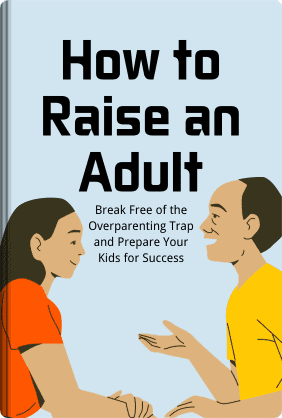
How to Raise an Adult
Julie Lythcott-Haims
33 Duration9 Key Points4.6 RateTeaching Kids Mental Toughness: What to Say When They Struggle
The words you use become your child's inner voice. Teaching kids mental toughness requires specific, intentional language that promotes self-efficacy rather than dependence.
Scenario: Your child didn't make the travel soccer team.
- Do not say: "The coach is blind, you were the best one out there. We'll find a better team." (This teaches them to blame others and play the victim).
- Say: "I know how disappointed you are. You really wanted this. It is okay to be sad right now. When you're ready, we can talk about how you want to practice for next year's tryouts."
Scenario: Your child is overwhelmed by a massive homework assignment.
- Do not say: "Here, let me just do the research part for you so you can go to bed." (This teaches them they cannot handle big tasks).
- Say: "This looks like a massive project. I understand why you feel stressed. Let's break this down into three small chunks. What is the very first thing you need to do?"
Scenario: Your child is scared to try something new, like a sleepaway camp.
- Do not say: "If you don't like it, I will come pick you up right away." (This gives them an immediate escape hatch and reinforces that the camp is a threat).
- Say: "It is completely normal to feel nervous about sleeping away from home. You are brave enough to feel scared and do it anyway. I can't wait to hear about it when you get back."
Managing Your Own Parental Anxiety
You cannot raise a resilient child if you are constantly operating out of fear. Children are incredibly perceptive. They absorb the emotional temperature of the room. If you project anxiety every time they climb a tree, take a test, or go to a friend's house, they will internalize the belief that the world is inherently dangerous and they are fragile.
Take time to regulate your own nervous system. Recognize your triggers. If you had a tough time socially in middle school, you might project that anxiety onto your child's social life. Separate your past from their present. Read books from Barnes & Noble or grab an audiobook from Audible on cognitive behavioral therapy for parents to keep your own fears in check.
For busy parents who want to absorb the wisdom from these kinds of books but struggle to find the time, an app can help.


LeapAhead

Get the core lessons from parenting and psychology bestsellers in 15-minute audio or text summaries, perfect for learning during a commute or after the kids are in bed.
Raising resilient kids is hard work. It requires you to sit on your hands and bite your tongue when every instinct screams at you to help. But the payoff is profound. You are not just raising a child; you are raising a future adult. Give them the gift of knowing they can handle whatever life throws their way.
Ultimately, the hardest part of raising resilient kids is managing your own internal reactions when things go wrong. Learning to separate your own childhood baggage from your child's current experience takes time, self-compassion, and practical boundary-setting. If you want a compassionate, highly actionable guide to becoming a sturdier, more regulated parent—one who can hold firm boundaries while still deeply connecting with your child—this transformative book is highly recommended.

Good Inside
Dr. Becky Kennedy
38 Duration7 Key Points4.6 RateWhile these strategies are tailored for children, remember that kids learn by observing. Modeling resilience in your own life is one of the most powerful teaching tools you have. Applying these same principles to your own challenges can reinforce the lessons for your entire family.
The journey of raising resilient kids is supported by continuous learning. If the book recommendations in this article resonated with you, there's a wealth of literature available to explore these concepts further.
FAQ
How do I know if my child is lacking resilience?
Signs of low resilience include melting down over minor setbacks (like a broken pencil or a changed dinner plan), giving up immediately when a task gets hard, avoiding new activities out of fear of failure, and heavily relying on you to mediate normal peer conflicts. If your child frequently says "I can't do it" before even trying, they need more practice with safe failures.
Signs of low resilience include melting down over minor setbacks (like a broken pencil or a changed dinner plan), giving up immediately when a task gets hard, avoiding new activities out of fear of failure, and heavily relying on you to mediate normal peer conflicts. If your child frequently says "I can't do it" before even trying, they need more practice with safe failures.
Is it too late to build resilience in my teenager?
It is never too late. The teenage brain is still highly plastic and constantly rewiring itself. While you cannot use toddler techniques, you can start enforcing natural consequences immediately. Stop waking them up for school, stop managing their schedule, and let them handle the fallout. Expect resistance at first, but stand firm.
It is never too late. The teenage brain is still highly plastic and constantly rewiring itself. While you cannot use toddler techniques, you can start enforcing natural consequences immediately. Stop waking them up for school, stop managing their schedule, and let them handle the fallout. Expect resistance at first, but stand firm.
How do I balance being supportive without being a helicopter parent?
Support looks like listening, validating emotions, and asking open-ended questions like, "What is your plan to handle this?" Helicopter parenting looks like anticipating problems before they happen, removing obstacles, and doing the work for them. A supportive parent provides the safety net; a helicopter parent removes the tightrope.
Support looks like listening, validating emotions, and asking open-ended questions like, "What is your plan to handle this?" Helicopter parenting looks like anticipating problems before they happen, removing obstacles, and doing the work for them. A supportive parent provides the safety net; a helicopter parent removes the tightrope.
What if my child has diagnosed anxiety or ADHD?
Children with clinical anxiety or ADHD absolutely need to build resilience, but the steps must be smaller and more structured. The core principles remain the same: do not remove every stressor. However, you should work closely with a therapist or counselor to establish a "ladder" of manageable challenges. Accommodations should help them access the challenge, not excuse them from facing it.
Children with clinical anxiety or ADHD absolutely need to build resilience, but the steps must be smaller and more structured. The core principles remain the same: do not remove every stressor. However, you should work closely with a therapist or counselor to establish a "ladder" of manageable challenges. Accommodations should help them access the challenge, not excuse them from facing it.