

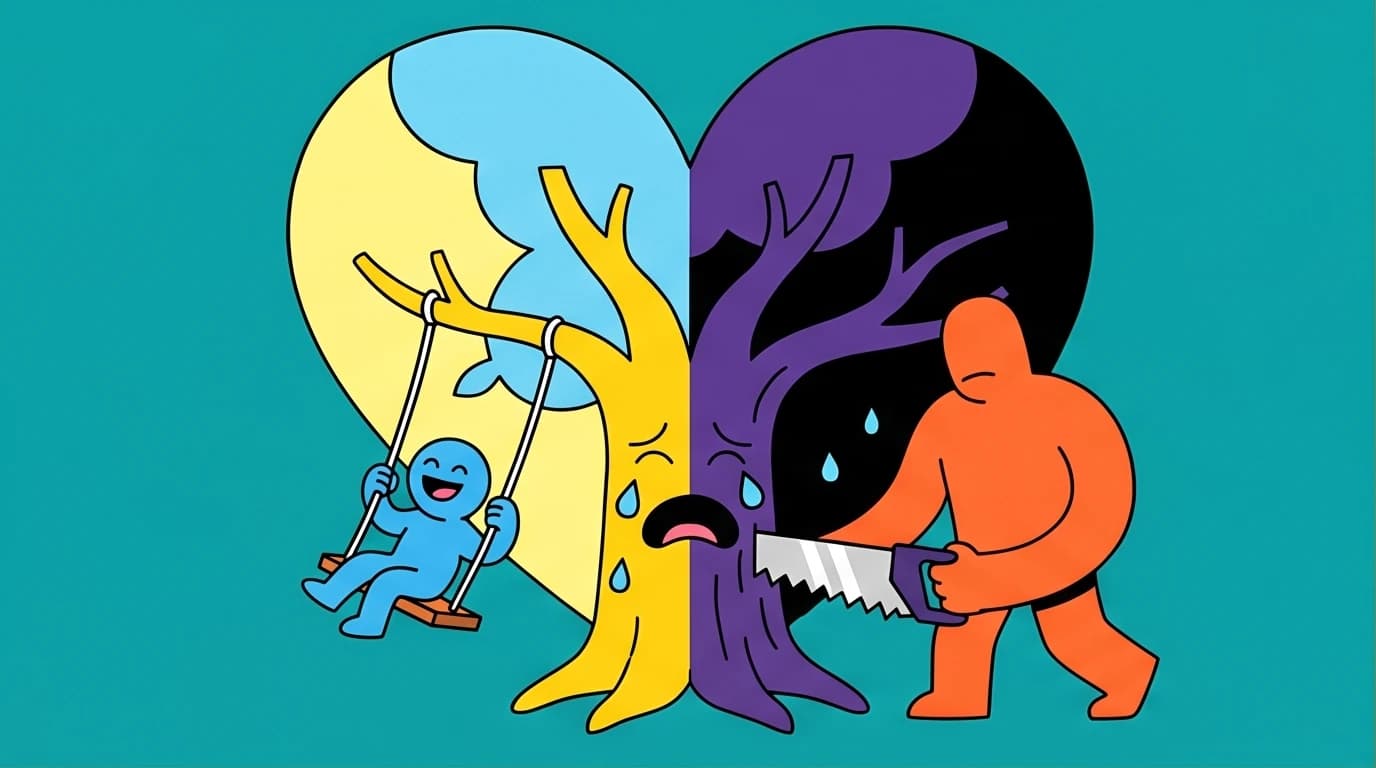
You probably remember Shel Silverstein’s 1964 classic from your own childhood. The story is simple: a boy loves a tree, and the tree gives him her leaves, her apples, her branches, and finally her trunk, until she is nothing but a stump. As a kid, it feels like a sweet, quiet story about a reliable friend.
Then you grow up. You pick up a copy at Barnes & Noble or order it on Amazon to read to your own kids. You sit down, open the familiar green cover, and as you read the final pages, a sudden wave of discomfort hits you. You realize the boy never once says "thank you." You realize the tree stripped herself bare for someone who only visited when he needed something.
You are left wondering if this beloved children's book is actually a blueprint for a highly dysfunctional relationship. You are not alone in this reaction. Decades after its publication, the debate around the core message of the book remains fiercely polarized. This complexity is a hallmark of Silverstein's work, which often blurs the line between children's literature and profound adult philosophy.
The Core Debate: Why We Question the Book Now
When The Giving Tree was first published, it was largely celebrated as a Christian allegory or a beautiful testament to the nature of giving. But our cultural understanding of mental health, emotional boundaries, and healthy relationships has evolved significantly.
We now recognize that love should not require total self-annihilation. We understand that giving until you are entirely empty is a fast track to resentment and burnout. This cultural shift is exactly why modern readers struggle with the story. To understand the book today, we have to look at it through multiple lenses.
Interpretation 1: A Beautiful Picture of Unconditional Love
If you view the story through the lens of pure altruism, unconditional love the giving tree displays is awe-inspiring.
From this perspective, the tree represents the ultimate ideal of a parent's love. Parents give their energy, their money, their youth, and their resources to ensure their children thrive. The tree expects absolutely nothing in return. Her joy is entirely tied to the boy’s happiness.
When the boy is young, he swings from her branches and eats her apples. It is a period of mutual joy. As he grows, his needs become more complex and materialistic—he wants money, a house, a boat to sail away. The tree provides the means for all of it.
Those who defend this interpretation argue that Silverstein was illustrating agape—the highest form of love, which is entirely selfless. The tree is not a victim; she is an active participant who chooses to give because giving is her purpose. When she is reduced to a stump and the old man sits on her, the text says, "And the tree was happy." For a brief moment, the transaction of material goods ends, and they are simply present with one another again.
Interpretation 2: The Dark Reality of a Toxic Relationship

On the flip side of the debate, many therapists and adult readers view the story as a massive red flag. The dynamic between the boy and the tree perfectly maps onto a classic model of exploitation.
When looking at the toxic relationship in the giving tree, the boy’s behavior is deeply narcissistic. He only returns to the tree when he experiences a deficit in his own life. He wants money, so he takes her apples to sell. He wants a house, so he cuts off her branches. He wants an escape, so he cuts down her trunk. He treats the tree not as a living entity worthy of respect, but as a resource to be mined.
The tree, in turn, exhibits classic martyr behavior. She sacrifices her own physical integrity to appease a boy who offers zero emotional reciprocity. She strips herself of her own identity—literally losing her ability to provide shade, bear fruit, or sway in the wind—just to keep him around for a few fleeting moments.
This interpretation suggests the book is a cautionary tale. It warns us what happens when we refuse to set boundaries. If you give everything to a taker, they will leave you as nothing but a stump, and they still won't be happy. Notice that despite getting everything he ever asked for, the boy returns as an old man who is tired, sad, and unfulfilled. This theme of searching for external validation instead of internal wholeness is a concept Silverstein explored from a different angle in another one of his famous fables.
If you found yourself nodding along to this interpretation, you likely understand how quickly a lack of boundaries can drain your emotional reserves. Giving endlessly to a taker doesn't just hurt you—it creates a toxic dynamic that is incredibly hard to break. If you're ready to stop feeling like the tree and want to reclaim your own identity, learning to say "no" without feeling guilty is the crucial first step. To dive deeper into establishing healthy limits and protecting your peace, check out this empowering guide.

Set Boundaries, Find Peace
Nedra Glover Tawwab
 29 Duration
 10 Key Points
 4.5 Rate
Exploring these concepts is a great step, but finding the time to read through multiple books on psychology and self-improvement can feel daunting.


LeapAhead

Absorb the core lessons from bestselling books on topics like boundaries and healthy relationships in just 15-minute summaries, perfect for learning on a tight schedule.
Diving Deeper: The Psychology of The Giving Tree
To truly grasp the impact of the story, we have to look at the psychology of the giving tree. The relationship models a severe case of codependency and enabling.
The Problem of Enabling
The tree wants to ease the boy’s discomfort at every stage of his life. Instead of letting him figure out how to earn money, she tells him to take her apples. Instead of letting him build his own life, she gives him her branches.
In psychology, this is known as enabling. By constantly removing the boy's obstacles, the tree robs him of the opportunity to develop resilience, gratitude, and self-sufficiency. The boy never learns how to create his own happiness because the tree is always jumping in to fix his life at her own expense.
It is a natural parental instinct to want to smooth the path for our kids, but stepping in to fix every problem usually does more harm than good. When we constantly remove hurdles, we inadvertently strip our children of the chance to build genuine self-confidence and problem-solving skills. If you want to shift away from an enabling parenting style and instead foster true independence, you have to learn how to comfortably step back. This insightful read offers fantastic, science-backed strategies for raising capable, self-sufficient kids who don't rely on you to clear their obstacles.
The Self-Driven Child
William Stixrud, Ph.D., Ned Johnson
43 Duration9 Key Points4.3 RateAttachment and Fear of Abandonment
Why does the tree keep giving? A psychological reading suggests a deep-seated fear of abandonment. The tree only feels valuable when she is useful. When the boy stays away for long periods, she becomes lonely and sad. When he returns, she is so desperate to keep him there that she offers pieces of herself.

Silverstein includes a brilliant, haunting line late in the book. After the tree gives the boy her trunk to build a boat so he can sail far away from her, the text reads: "And the tree was happy... but not really."
This is the psychological crux of the story. It is the exact moment cognitive dissonance sets in. You cannot be truly happy when you have destroyed yourself to facilitate someone else's escape.
That haunting realization—that you can give away your entire core and still feel empty—is the ultimate hallmark of a codependent relationship. Many of us fall into the trap of believing our worth is entirely defined by how useful we are to the people we love. But true connection shouldn't require you to chop yourself into pieces. If you recognize a pattern of abandoning your own needs to keep others happy, it might be time to break the cycle. This classic book is a lifeline for anyone ready to heal from enabling behaviors and start prioritizing their own well-being.

Codependent No More
Beattie Melody
19 Duration8 Key Points4.6 RateA Broader Perspective: The Giving Tree Analysis
While the relationship dynamic is the most common focus, a comprehensive the giving tree analysis must also consider the environmental interpretation.

Many readers view the boy as humanity and the tree as Mother Nature. As a child (early humanity), the boy lives in harmony with nature. He gathers leaves, climbs the trunk, and eats the fruit. The relationship is sustainable.
As the boy grows into modern man, capitalism and industrialization take over. He demands profit (selling apples in the city), housing (cutting branches), and eventually transportation and expansion (cutting the trunk for a boat). Nature gives endlessly until it is completely depleted, resulting in a barren landscape where humanity is left old, tired, and sitting on the ruins of the natural world. This interpretation holds incredible weight today, making the book a profound commentary on environmental conservation.
Should You Read It to Your Kids?
If you are a parent or educator, you might be tempted to hide the book or donate it. You do not want your children thinking they need to chop themselves into pieces to be loved, nor do you want them thinking it is acceptable to treat others like a disposable resource.
However, banning the book misses a massive opportunity. The Giving Tree remains an exceptional teaching tool precisely because it is so provocative. You can use it to teach your kids the exact concepts you are worried they might miss.
Here is how to approach it:
- Do not read it passively. Stop at key moments and ask your child questions.
- Challenge the boy's actions. Ask, "Do you think the boy is being a good friend right now? What should he have said to the tree?"
- Discuss boundaries. Ask, "If you were the tree, would you have given away your trunk? What else could the tree have said?"
- Identify emotions. Point to the tree when she is just a stump and ask, "The book says she was happy, but look at the picture. Do you think she is really happy? Why or why not?"
Kids are incredibly perceptive. By asking these questions, you guide them to recognize the imbalance in the relationship. They learn empathy by identifying the boy's selfishness, and they learn self-respect by questioning the tree's lack of boundaries.
Navigating these complex conversations with your kids doesn't just teach them about boundaries—it helps you break generational patterns of people-pleasing and emotional burnout. Mindful parenting is about modeling healthy self-respect just as much as it is about teaching empathy. By openly discussing the flaws in the tree's endless sacrifices, you're already laying the groundwork for your children to build balanced, respectful relationships. If you're looking for more actionable ways to raise emotionally intelligent, compassionate kids without losing your cool (or yourself) in the process, this highly recommended guide is a must-read.
Raising Good Humans
Hunter Clarke-Fields MSAE, Carla Naumburg PhD, et al.
22 Duration7 Key Points4.8 RateThe Genius of Shel Silverstein
Perhaps the true meaning of the book lies in its ambiguity. Shel Silverstein notoriously refused to explain the book's core message. When pressed, he would simply state that it was a story about two people, and that one gives and the other takes.
Silverstein did not write a prescriptive moral fable. He held up a mirror to human relationships. The book forces you to project your own experiences, your own traumas, and your own understanding of love onto its pages. If you are a burnt-out parent, you might see a tragedy. If you are deeply religious, you might see divine grace.
The Giving Tree survives as a cultural touchstone because it refuses to be simple. It forces us to confront the uncomfortable space where love, sacrifice, selfishness, and regret intersect. His unique ability to pack complex themes into simple narratives is evident across his entire collection, inviting readers to explore his other celebrated works.
This kind of self-reflection often inspires a desire to learn more. If you're ready to explore these complex topics further but struggle to fit reading into your busy life, a new approach to learning might help.
LeapAhead
Grasp the key ideas from influential books on psychology, parenting, and personal growth in 15-minute audio or text explainers, turning any spare moment into an opportunity for insight.
FAQ
What did Shel Silverstein say about the meaning of The Giving Tree?
Shel Silverstein actively avoided giving a definitive explanation of the book's meaning. He famously resisted the idea that children's books had to have clear, happy morals. He simply described it as a story about a relationship between two beings where one gives and the other takes, leaving the interpretation entirely up to the reader.
Shel Silverstein actively avoided giving a definitive explanation of the book's meaning. He famously resisted the idea that children's books had to have clear, happy morals. He simply described it as a story about a relationship between two beings where one gives and the other takes, leaving the interpretation entirely up to the reader.
Does The Giving Tree promote a toxic view of motherhood?
Many critics and modern readers argue that it does. The tree is often read as a maternal figure who literally destroys herself to satisfy her son's endless, ungrateful demands. This dynamic mirrors the "martyr complex" often pushed onto mothers, suggesting that "good" mothers must sacrifice their own physical and mental well-being for their children.
Many critics and modern readers argue that it does. The tree is often read as a maternal figure who literally destroys herself to satisfy her son's endless, ungrateful demands. This dynamic mirrors the "martyr complex" often pushed onto mothers, suggesting that "good" mothers must sacrifice their own physical and mental well-being for their children.
Is The Giving Tree a good book for children today?
Yes, but it is best used as a conversation starter rather than a traditional bedtime story. Because modern psychology recognizes the dangers of the tree's lack of boundaries and the boy's narcissism, parents can use the book to ask kids critical questions about friendship, gratitude, and when it is okay to say "no."
Yes, but it is best used as a conversation starter rather than a traditional bedtime story. Because modern psychology recognizes the dangers of the tree's lack of boundaries and the boy's narcissism, parents can use the book to ask kids critical questions about friendship, gratitude, and when it is okay to say "no."
Why does the book say the tree was "happy... but not really"?
This line occurs after the tree gives away her trunk so the boy can build a boat and sail away. It represents the psychological reality of codependency. The tree thinks giving will make her happy because it appeases the boy, but she is left completely destroyed and alone. It is a moment of profound realization that sacrificing your core self does not lead to genuine joy.
This line occurs after the tree gives away her trunk so the boy can build a boat and sail away. It represents the psychological reality of codependency. The tree thinks giving will make her happy because it appeases the boy, but she is left completely destroyed and alone. It is a moment of profound realization that sacrificing your core self does not lead to genuine joy.