


You know Benjamin Graham’s classic is considered the ultimate investing bible, famously endorsed by Warren Buffett. But let's be honest: sitting down with a dense, 600-page financial textbook written decades ago is a massive time commitment. You want the practical frameworks and rules of value investing without wading through outdated bond yields and historical market data from the 1970s.
Here is exactly how Benjamin Graham thinks about money, risk, and the stock market, structured so you can apply his timeless wisdom to your modern portfolio today.
The book's density, however, often leads potential readers to question if it's the right starting point for their financial journey.
And if even a detailed summary feels like a hurdle, a great first step can be to absorb the core concepts in a more modern, condensed format.

Grasp the core principles of value investing from classics like The Intelligent Investor in just 15 minutes, perfect for when you lack the time to tackle the full 600-page book.

Download LeapAhead App now
Investment vs. Speculation: Draw the Line
The very first lesson in this Benjamin Graham book summary is the hard boundary between investing and speculating. Most people who think they are investing are actually speculating.
Graham defines an investment with a very specific criteria: An investment operation is one which, upon thorough analysis, promises safety of principal and an adequate return. Operations not meeting these requirements are speculative.
If you buy a stock simply because the chart is going up, or because you saw it trending on social media, you are speculating. You are gambling that a greater fool will pay more for it tomorrow. An intelligent investor, however, views a stock not as a ticker symbol, but as an ownership stake in a real business. You analyze the underlying fundamentals, buy it at a reasonable price, and plan to hold it regardless of short-term market noise.

Know Your Profile: Defensive vs. Enterprising Investors
Graham argues that your returns shouldn't depend on how much risk you are willing to take, but rather on how much effort you are willing to put into your portfolio. He splits investors into two distinct camps. You must pick one and never mix the strategies.
The Defensive Investor
This represents 90% of people. The defensive investor is a busy professional who does not have the time, expertise, or desire to analyze financial statements.
- Goal: Protect against inflation, avoid serious mistakes, and achieve average market returns with minimal effort.
- Strategy: Create a highly diversified, automated portfolio.
- Modern Application: Buying broad-market index funds (like an S&P 500 fund through Vanguard or Fidelity). Graham advocated for a strict asset allocation rule: keep your portfolio divided between stocks and high-quality bonds. Never hold less than 25% or more than 75% in either asset class. When stocks surge, rebalance to take profits. When stocks tank, rebalance to buy cheap.
If you recognize yourself as a defensive investor, the easiest way to implement Graham's strategy is through low-cost index funds. To master this specific approach without getting bogged down in complex stock analysis, you might want to explore the definitive guide written by the very creator of the index fund. It's an excellent, straightforward read that reinforces why "boring" passive investing usually beats active trading over the long haul.
The Little Book of Common Sense Investing
John Bogle
 41 Duration
 8 Key Points
 4.6 Rate
The Enterprising Investor
This investor is willing to dedicate serious time and energy to market research. They are professionals or highly dedicated amateurs looking for better-than-average returns.
- Goal: Beat the market average through rigorous, continuous analysis.
- Strategy: Hunt for mispriced securities. Enterprising investors look for companies trading below their net working capital, unpopular large caps, or special situations (like mergers and acquisitions).
- The Trap: If you try to be an enterprising investor but only put in half the effort, you will underperform the defensive investor. If you don't have hours every week to read SEC filings, default to the defensive approach.
Meet "Mr. Market": The Psychology of Investing
You cannot read a thorough The Intelligent Investor summary without addressing Chapter 8. It contains the most powerful metaphor in finance: Mr. Market.
Imagine you own a share in a business, and your partner is a highly emotional man named Mr. Market. Every single day, without fail, Mr. Market knocks on your door and offers you a price to either buy your share or sell you his.
The catch? Mr. Market is manic-depressive.
When the business is doing well, he gets euphoric and quotes ridiculously high prices. When the economy hits a rough patch, he panics and offers to sell you his shares for pennies on the dollar.

When the business is doing well, he gets euphoric and quotes ridiculously high prices. When the economy hits a rough patch, he panics and offers to sell you his shares for pennies on the dollar.
Your job as an intelligent investor is not to be influenced by Mr. Market’s mood swings. You do not have to trade with him just because he shows up. You should only interact with him when his mood works in your favor. Sell to him when he is overly optimistic (prices are drastically overvalued). Buy from him when he is depressed (prices are heavily discounted).
Never let Mr. Market dictate the true value of your assets.
Mastering your own emotional reactions to Mr. Market is often much harder than doing the actual math. If you find yourself struggling with the emotional side of investing, or just want to better understand why smart people make irrational financial decisions during market swings, diving deeper into behavioral finance is incredibly rewarding. There are fantastic modern resources that perfectly complement Graham's timeless lessons on human psychology and wealth building.
The Psychology of Money
Morgan Housel
48 Duration7 Key Points4.6 RateThe Secret to Risk Management: Margin of Safety
If there is one phrase you take away from this book, it should be Margin of Safety. Graham called it the central concept of investment.
Imagine a bridge engineered to hold exactly 10,000 pounds. Would you drive a 9,900-pound truck across it? Probably not. A tiny miscalculation in the engineering could lead to a disaster. Instead, you would want a bridge built to hold 30,000 pounds before driving your 10,000-pound truck over it. That 20,000-pound gap is your margin of safety.
In investing, you apply this by refusing to overpay for a stock, no matter how great the company is. You calculate what a business is intrinsically worth, and you only buy it when the market price is significantly lower than that true value.

If a company is fundamentally worth $50 a share, an intelligent investor tries to buy it at $35. That $15 discount protects you. If your initial analysis was slightly wrong, or if the economy hits an unexpected recession, the margin of safety absorbs the blow and prevents permanent loss of capital.
This single concept is so foundational to Graham's entire philosophy that it's worth exploring in greater detail.
The Intelligent Investor Chapter Summary: Where to Focus
Reading the entire 600-page book is daunting, especially because the core concepts are front-loaded and back-loaded. If you own the revised edition (featuring brilliant modern commentary by Jason Zweig, highly recommended if you are buying a copy from Amazon or Barnes & Noble), here is how you should navigate the material.
- Chapters 1-7 (Portfolio Strategy): These cover the basic rules for both defensive and enterprising investors. They explain asset allocation, the dangers of inflation, and why you should avoid new stock issues (IPOs) and high-yield junk bonds.
- Chapter 8 (The Investor and Market Fluctuations): The single most important chapter in the book. This is where Graham introduces Mr. Market and explains the psychology of investing. If you only read one chapter, read this.
- Chapters 9-19 (Financial Analysis): This is the heavy, technical section. Graham breaks down how to read balance sheets, analyze per-share earnings, and compare companies. Unless you are an active stock picker (an enterprising investor), you can skim this section.
- Chapter 20 (Margin of Safety): The second most important chapter. Graham ties his entire philosophy together by explaining risk reduction and why buying assets on sale is the only reliable way to build wealth over decades.
Even with a comprehensive summary, there is no substitute for the source material—especially if you want to become a truly enterprising investor. If you are ready to take the plunge, make sure you pick up the revised edition that includes Jason Zweig’s brilliant contemporary commentary. It translates Graham's mid-century examples into modern market events, making the concepts incredibly easy to grasp and apply today.
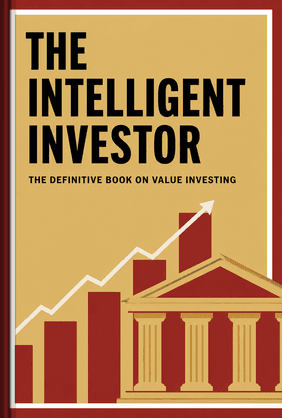
The Intelligent Investor
Benjamin Graham, Jason Zweig
41 Duration8 Key Points4.7 RateThe Intelligent Investor Cheat Sheet: Modern Application
To bridge the gap between 1949 and today, here is The Intelligent Investor cheat sheet. These are the immediate, actionable The Intelligent Investor key takeaways you can apply to your brokerage account right now.
- Stop trying to predict the market. Nobody knows what the stock market will do tomorrow, next week, or next year. Build a portfolio that survives regardless of what the market does.
- Automate your buying. Dollar-cost averaging (investing a set amount of money every single month, whether the market is up or down) is the ultimate defensive strategy. It forces you to buy more shares when prices are cheap and fewer when prices are expensive.
- Boring is profitable. Exciting investments—like the latest tech IPO or a trendy cryptocurrency—are often speculative traps. Consistent, reliable companies with strong balance sheets and dividend histories are where wealth is built.
- Ignore the financial news. Wall Street media makes money by generating panic and hype. Turn off the financial news networks. They are the megaphone for Mr. Market's manic episodes.
- Focus on what you control. You cannot control stock prices, interest rates, or the economy. You can control your savings rate, your asset allocation, your investment fees, and your own emotional reactions.
- Demand a discount. Never buy a stock priced for perfection. Always ensure a wide margin of safety to protect your downside.
Applying Graham's rules requires discipline, but it has created some of the greatest fortunes in history. If you want to see exactly how Graham's most famous student took these core principles—like the margin of safety and emotional control—and built a multi-billion dollar empire, studying Warren Buffett's specific strategies is the perfect next step. It shows you how these timeless value investing rules look in action at the highest level of modern finance.
The Warren Buffett Way
Robert Hagstrom, Stephen Hoye, et al.
24 Duration8 Key Points4.7 RateBuilding this kind of financial knowledge takes time, and fitting dense books from investing legends like Graham and Buffett into a busy schedule can be challenging.
Turn your commute into a productive learning session by listening to key insights from the world's best investing books, helping you build your financial literacy without the heavy reading.
Download LeapAhead App now
FAQ
Do I need to read the entire book if I am a beginner?
No. The book is incredibly dense and uses historical financial data that can confuse beginners. Start by reading Chapter 8 (on market fluctuations) and Chapter 20 (on the margin of safety). Those two chapters contain 90% of the practical philosophy. If you read a modern version, read Jason Zweig’s chapter summaries—they translate Graham’s older examples into recent market events.
No. The book is incredibly dense and uses historical financial data that can confuse beginners. Start by reading Chapter 8 (on market fluctuations) and Chapter 20 (on the margin of safety). Those two chapters contain 90% of the practical philosophy. If you read a modern version, read Jason Zweig’s chapter summaries—they translate Graham’s older examples into recent market events.
Is Benjamin Graham's advice still relevant in today's tech-heavy stock market?
Absolutely. While the specific companies and industries have changed, human psychology remains exactly the same. The fear and greed that drove the railroad bubbles in Graham's era are the exact same emotions driving modern tech bubbles and market crashes. The rules of avoiding speculation and demanding a margin of safety never expire.
Absolutely. While the specific companies and industries have changed, human psychology remains exactly the same. The fear and greed that drove the railroad bubbles in Graham's era are the exact same emotions driving modern tech bubbles and market crashes. The rules of avoiding speculation and demanding a margin of safety never expire.
What is the simplest way to be a "Defensive Investor" today?
The modern equivalent of Graham's defensive strategy is to buy low-cost, broad-market index funds (such as an S&P 500 or Total Stock Market index fund). Set up automatic monthly contributions to these funds, maintain an emergency cash reserve, and refuse to check your portfolio balance when the market is crashing.
The modern equivalent of Graham's defensive strategy is to buy low-cost, broad-market index funds (such as an S&P 500 or Total Stock Market index fund). Set up automatic monthly contributions to these funds, maintain an emergency cash reserve, and refuse to check your portfolio balance when the market is crashing.
How is Warren Buffett connected to this book?
Warren Buffett read The Intelligent Investor when he was 19 years old, and it completely changed his life. He later studied directly under Benjamin Graham at Columbia University and worked at Graham's investment firm. Buffett frequently calls it "by far the best book on investing ever written" and credits the concepts of Mr. Market and the Margin of Safety as the foundation of his immense wealth.
Warren Buffett read The Intelligent Investor when he was 19 years old, and it completely changed his life. He later studied directly under Benjamin Graham at Columbia University and worked at Graham's investment firm. Buffett frequently calls it "by far the best book on investing ever written" and credits the concepts of Mr. Market and the Margin of Safety as the foundation of his immense wealth.