

You have seen this 400-page book sitting heavily on a Barnes & Noble display table or dominating your Audible recommendations. It is a brilliant piece of behavioral economics that won a Nobel Prize. It is also incredibly dense. If you are an executive making high-stakes choices or an investor managing a portfolio, you do not have forty hours to sift through decades of academic experiments.
For those who want to grasp the core ideas of books like this but find their schedules packed, a summary app can be a powerful tool.


LeapAhead

Absorb the key lessons from dense books like Thinking, Fast and Slow in just 15-minute audio or text explainers, perfect for a busy commute.
You need the bottom line. You need to know how your brain betrays you and how to stop it.
This guide serves as your comprehensive
thinking fast and slow summary. We will strip away the academic padding and extract the precise mechanisms driving human behavior. Consider this your definitive set of thinking fast and slow cliff notes, engineered to help you recognize cognitive traps and make strictly better decisions immediately.The Foundation: Two Systems Running Your Mind
To grasp any
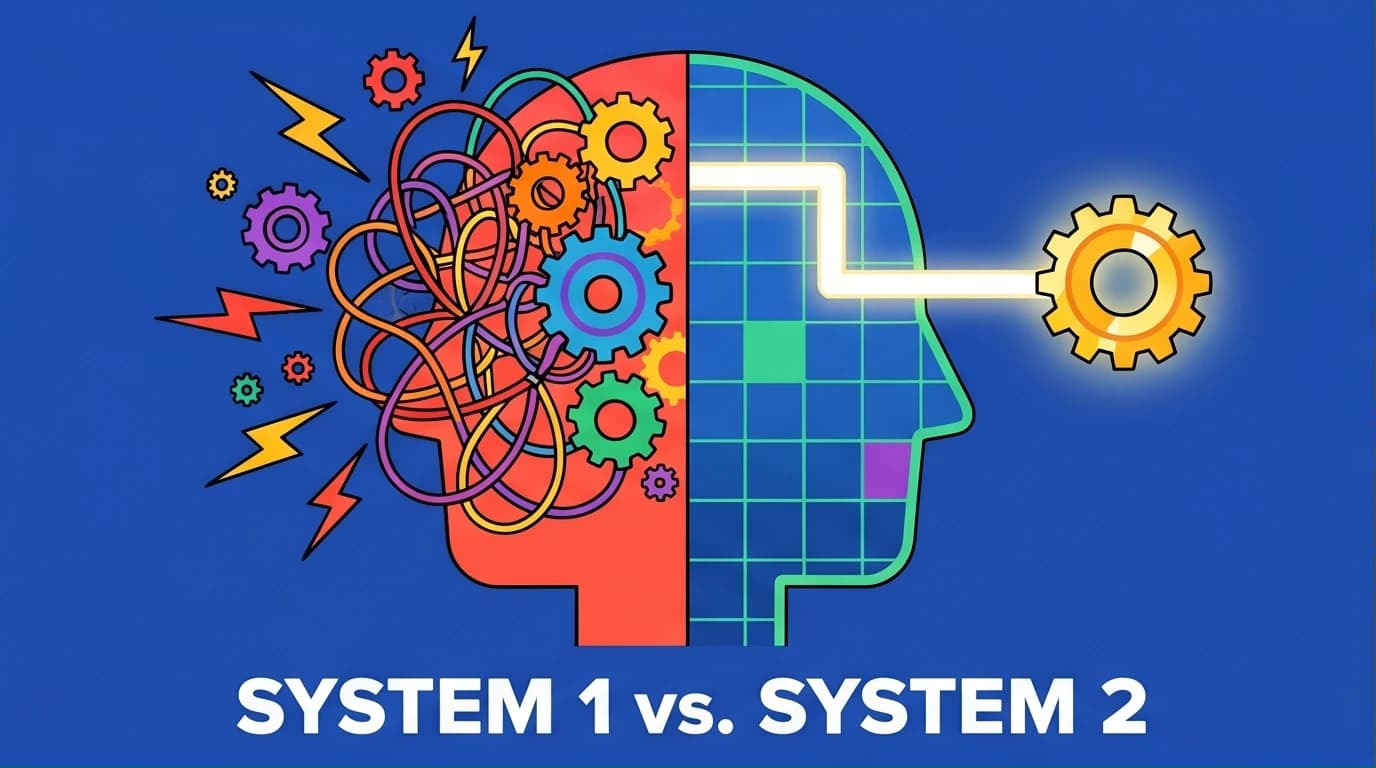
daniel kahneman thinking fast and slow summary, you must first understand the central characters of the book: System 1 and System 2. They dictate every choice you make, from buying a coffee to authorizing a multimillion-dollar merger.System 1: The Fast Thinker
System 1 operates automatically and quickly, with little or no effort and no sense of voluntary control. It is the survival mechanism of the brain.
- What it does: Detects hostility in a voice, drives a car on an empty highway for miles, reads words on large billboards, and understands simple social cues.
- The flaw: It is gullible. System 1 believes what it sees, runs on emotions, and constantly tries to construct a coherent story out of incomplete data. It cannot handle complex statistics.
System 2: The Slow Thinker
System 2 allocates attention to the effortful mental activities that demand it, including complex computations.
- What it does: Parks in a tight space, fills out tax forms, analyzes a 401(k) investment strategy, and calculates 17 x 24.
- The flaw: It is extremely lazy. System 2 requires high energy consumption. Instead of evaluating every situation, it usually defaults to the quick conclusions handed to it by System 1.
Most of the time, System 1 runs the show while System 2 acts as an inattentive supervisor. When System 1 encounters a problem it cannot solve, it calls on System 2. However, because System 2 is lazy, we often rely on System 1 for complex decisions. This mismatch generates systematic errors known as cognitive biases.
The interplay between these two modes of thought is the engine driving human judgment and error. To fully appreciate how they compete for control of your mind, it helps to see more real-world examples of their dynamics.
Since this entire guide summarizes Kahneman's brilliant framework, there is truly no substitute for reading the source material itself. If you want to dive deeper into the original research and fully grasp how System 1 and System 2 dictate your everyday life, grabbing a copy of his Nobel Prize-winning masterpiece is an absolute must for your reading list.
Thinking, Fast and Slow
Daniel Kahneman
 53 Duration
 9 Key Points
 4.5 Rate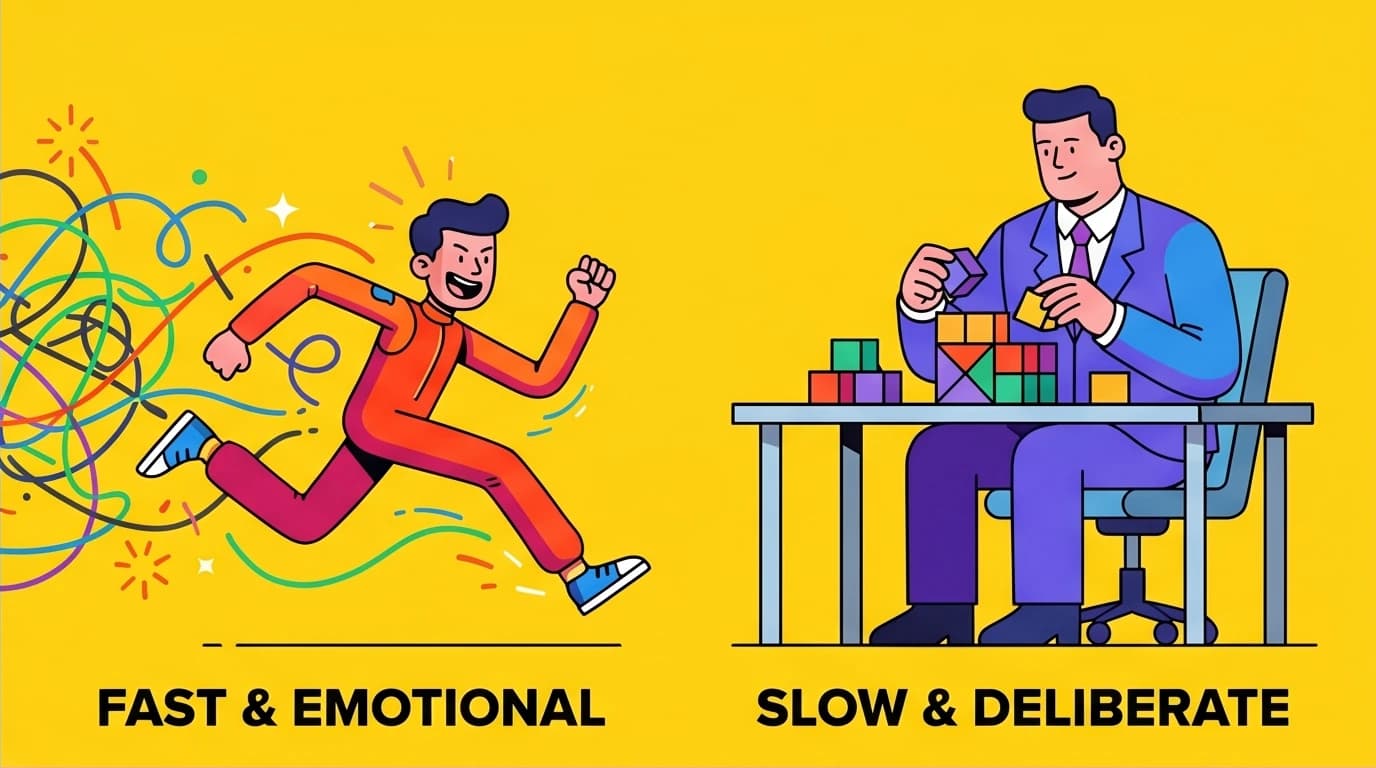
A Targeted Thinking Fast and Slow Chapter Summary
The original text is divided into five parts. Rather than a tedious page-by-page recount, this
thinking fast and slow chapter summary organizes Kahneman’s insights by the actual mental traps you will encounter in the real world.1. Heuristics and Biases (Mental Shortcuts)
When faced with a difficult question, System 1 substitutes an easier question to answer it quickly. This process is called a heuristic.
- The Anchoring Effect: Your mind relies heavily on the first piece of information it receives. If you are negotiating the purchase of a house, the initial asking price becomes the "anchor." Even if you know the price is absurdly high, your subsequent counteroffers will be unconsciously pulled toward that initial number.
- The Availability Heuristic: We judge the frequency or importance of an event based on how easily examples come to mind. Because media coverage of plane crashes is intense, people often fear flying. In reality, you are statistically far more likely to die driving a few miles to the airport. You overestimate risks that are dramatic and underestimate risks that are boring.
- The Halo Effect: The tendency to like or dislike everything about a person—including things you have not observed. If an executive presents well and wears a great suit, System 1 assumes their business strategy is equally flawless.
These are just a few of the many mental shortcuts Kahneman identifies. Our reliance on System 1 leads to a wide range of predictable errors in judgment that affect everything from our finances to our relationships.
2. The Illusion of Understanding (Overconfidence)
Kahneman aggressively dismantles the illusion that humans can predict the future or fully understand the past.
- Narrative Fallacy: We constantly fool ourselves by constructing flimsy accounts of the past and believing they are true. We look at a successful company like Amazon and create a neat, organized story about inevitable success, ignoring the massive role of luck.
- Hindsight Bias: "I knew it all along." Once an event occurs, we immediately update our memory to pretend we expected it. This makes executives overly harsh on employees for failing to predict unpredictable market shifts.
- The Illusion of Validity: Professionals often believe highly in their own skills, even when data proves otherwise. Kahneman points out that the year-to-year correlation of success among Wall Street stock pickers is virtually zero. They are playing a game of chance, yet their System 1 creates a powerful illusion of skill.
3. Choices and Risk (Prospect Theory)
This section is the core of Kahneman's Nobel Prize. Before Prospect Theory, economists assumed humans were strictly rational agents who made decisions to maximize utility. Kahneman proved this false.
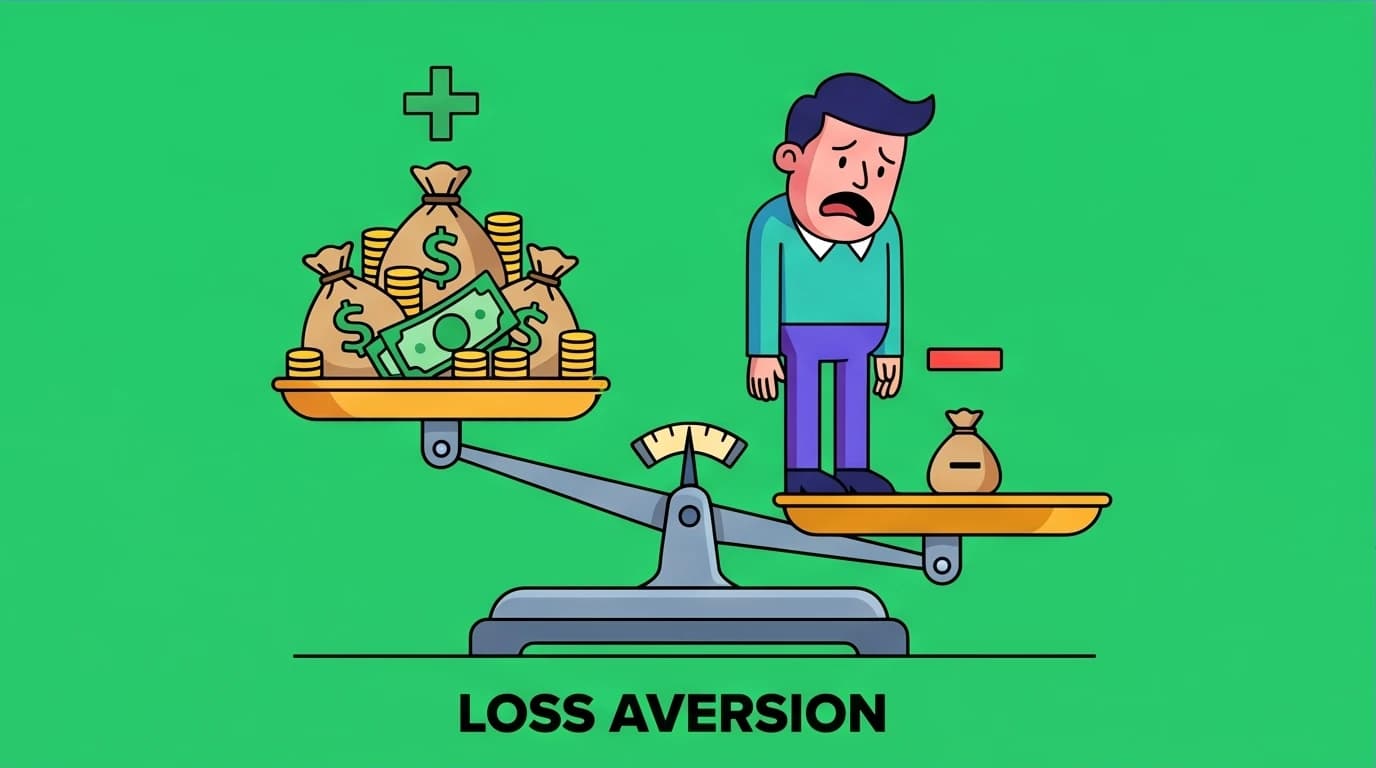
- Loss Aversion: Humans are wired to fear losses far more than we value equivalent gains. Losing $1,000 causes a psychological pain that is roughly twice as intense as the joy of winning $1,000. This is why investors hold onto losing stocks for too long—selling makes the loss real.
- The Sunk Cost Fallacy: Because we hate accepting a loss, we continue investing time, money, and effort into failing projects. Whether it is a failing startup, a toxic relationship, or a bad software implementation, we throw good money after bad to avoid admitting the initial investment was wasted.
- Framing Effects: The way information is presented completely alters your decision. A surgeon telling a patient, "You have a 90% chance of survival," elicits a completely different emotional response than, "You have a 10% chance of dying." The statistics are identical; the System 1 reaction is entirely different.
The realization that humans are far from rational economic actors can be surprising, but Kahneman wasn't the only researcher to expose our flawed logic. If you are fascinated by how easily framing effects and hidden emotions hijack our wallets, you will find Dan Ariely's exploration of human irrationality equally eye-opening. It is a fantastic follow-up offering even more real-world examples of how we consistently make illogical choices.

Predictably Irrational
Dan Ariely
23 Duration10 Key Points4.6 Rate4. The Two Selves
Kahneman introduces a striking conflict between how we experience life and how we remember it.
- The Experiencing Self: The part of you living in the present moment, answering the question, "Does it hurt right now?"
- The Remembering Self: The part of you that keeps score and makes choices for the future, answering the question, "How was it on the whole?"
The Peak-End Rule: The Remembering Self does not care about the duration of an experience. It evaluates an event based entirely on two moments: the most intense point (the peak) and the end. If you go on a two-week vacation to Hawaii with perfect weather, but lose your passport and get food poisoning on the final day, your Remembering Self will categorize the entire trip as a disaster.
Thinking Fast and Slow Key Takeaways You Can Apply Today
Understanding cognitive biases is only half the battle. The true value lies in application. Here are the crucial
thinking fast and slow key takeaways translated into immediate action items for your daily operations.1. Slow Down High-Stakes Decisions
You cannot force System 2 to run all the time; you would exhaust yourself. Reserve your mental energy for critical choices. When evaluating a major investment, hiring a senior leader, or signing a contract, deliberately slow down. Ask yourself: Is this a System 1 reaction based on emotion, or a System 2 decision backed by data?
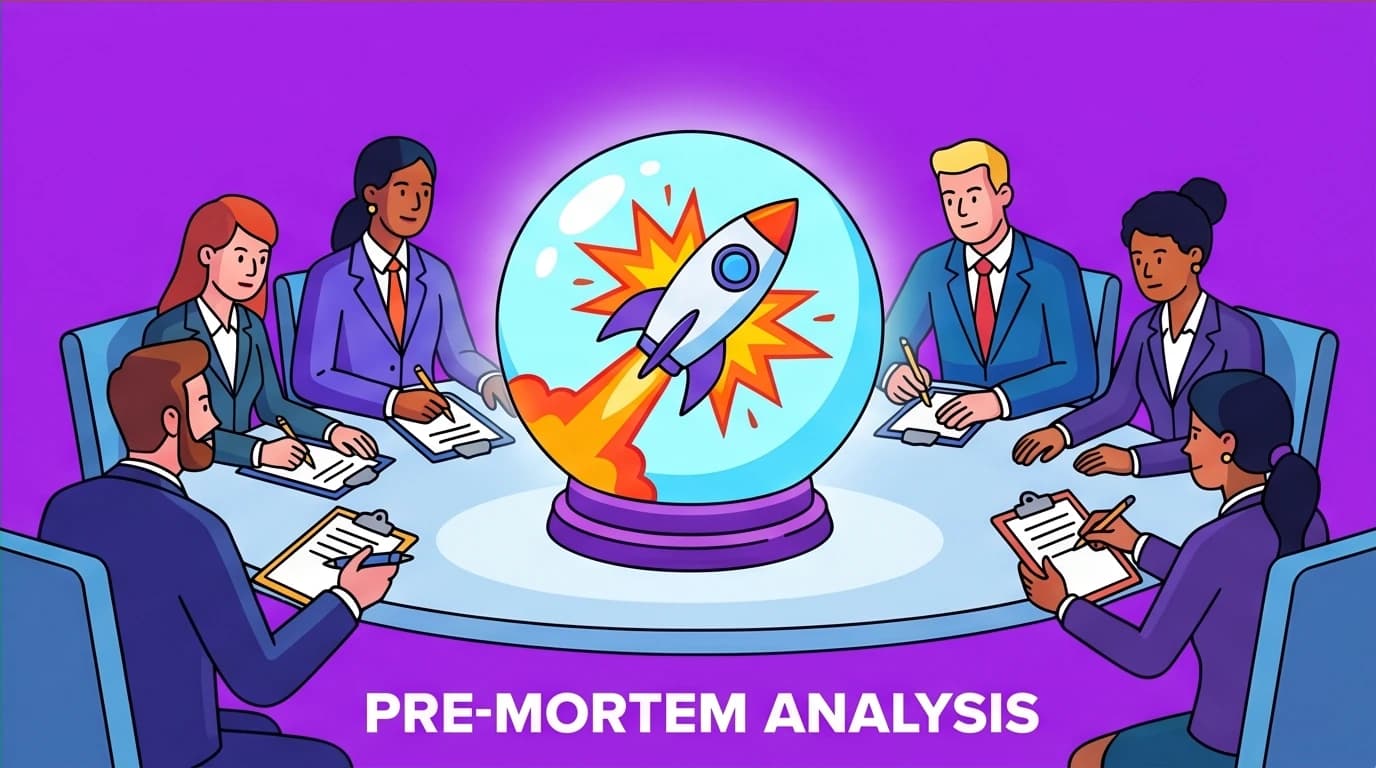
2. Implement the "Pre-Mortem" Technique
To combat overconfidence and the illusion of validity in business planning, use a pre-mortem. Before launching a major initiative, gather your team and say: "Imagine it is one year from today. We implemented the plan, and it was a complete disaster. Take ten minutes to write down a brief history of that disaster." This forces System 2 to actively look for flaws, breaking the groupthink and blind optimism that usually surrounds new projects.
3. Broaden Your Framing
Narrow framing causes us to view decisions in isolation, leading to conservative, fear-based choices driven by loss aversion. Instead of looking at a single stock trade or a single marketing campaign, look at your portfolio of decisions. Accept that some will fail. By viewing decisions as a repeated game, you reduce the emotional sting of individual losses and make more rational, mathematically sound bets.
Shifting your mindset to view decisions as a portfolio of bets rather than guaranteed outcomes is one of the most powerful ways to overcome loss aversion. Former professional poker player Annie Duke takes this exact concept and turns it into a masterclass on navigating uncertainty. Her insights will help you detach from the emotional sting of a single bad outcome and start making smarter, high-stakes choices based on solid probability.
Thinking in Bets
Annie Duke
36 Duration8 Key Points4.6 Rate4. Optimize the "Endings" for Customers
Leverage the Peak-End Rule in your product design and customer service. Customers will not remember every detail of their interaction with your brand. They will remember the most intense moment of friction or joy, and how the experience ended. Put disproportionate resources into ensuring the final touchpoint—whether it is a checkout process, unboxing, or an offboarding call—is exceptionally positive.
Putting these strategies into practice is key to improving your decision-making. For more specific techniques you can use in business, marketing, and investing, explore how to apply these psychological insights in your professional life.
Overcoming Your Own Mind
Reading about biases does not automatically make you immune to them. Kahneman himself admitted that after decades of studying behavioral economics, his own System 1 was just as prone to jumping to conclusions as anyone else's.
The goal is not to eliminate System 1. You need its speed to survive. The goal is to build an environment, both in your personal life and within your organization, that catches cognitive errors before they cause irreversible damage. Use checklists, demand opposing viewpoints, and never accept a baseline prediction without questioning the anchor.
By applying these insights, you stop fighting your brain and start managing it.
As you work to build a mental framework that catches cognitive errors, it helps to understand the brilliant minds that first discovered them. The groundbreaking concepts in this guide were the result of a legendary, intensely collaborative partnership between Daniel Kahneman and Amos Tversky. To truly appreciate the history behind behavioral economics and the friendship that reshaped our understanding of the human mind, this captivating narrative by Michael Lewis is an essential read.

The Undoing Project
Michael Lewis
19 Duration8 Key Points3.9 RateIf this summary has inspired you to tackle more classics of behavioral economics but your bookshelf is already overflowing, there's a more efficient way to get started.
LeapAhead
Clear your 'reading debt' by listening to the core insights from this book and hundreds of others, turning your workout or drive time into learning time.
FAQ
Is Thinking, Fast and Slow worth reading if I already know the basics of cognitive biases?
Yes, but selectively. If you already understand the fundamentals of anchoring and loss aversion, skip the introductory chapters and dive straight into Part 4 (Choices) and Part 5 (Two Selves). These sections contain the heaviest concentration of Kahneman’s original, groundbreaking work on Prospect Theory and memory, which are often poorly summarized in secondary literature.
Yes, but selectively. If you already understand the fundamentals of anchoring and loss aversion, skip the introductory chapters and dive straight into Part 4 (Choices) and Part 5 (Two Selves). These sections contain the heaviest concentration of Kahneman’s original, groundbreaking work on Prospect Theory and memory, which are often poorly summarized in secondary literature.
How do I force System 2 to activate when I am under pressure?
Create physical or procedural friction. When under pressure, System 1 wants to act immediately to relieve the stress. You can force System 2 to wake up by mandating a 24-hour waiting period for major financial decisions, or by forcing yourself to write out the rationale on paper. Writing requires structure and logic, which automatically engages System 2.
Create physical or procedural friction. When under pressure, System 1 wants to act immediately to relieve the stress. You can force System 2 to wake up by mandating a 24-hour waiting period for major financial decisions, or by forcing yourself to write out the rationale on paper. Writing requires structure and logic, which automatically engages System 2.
What is the single most dangerous bias mentioned in the book?
Overconfidence. Kahneman views overconfidence as the most damaging bias because it blinds us to all other errors. It prevents individuals from seeking advice, leads to reckless financial forecasting, and causes executives to double down on bad decisions rather than cutting their losses. Recognizing your own ignorance is the strongest defense against poor decision-making.
Overconfidence. Kahneman views overconfidence as the most damaging bias because it blinds us to all other errors. It prevents individuals from seeking advice, leads to reckless financial forecasting, and causes executives to double down on bad decisions rather than cutting their losses. Recognizing your own ignorance is the strongest defense against poor decision-making.