

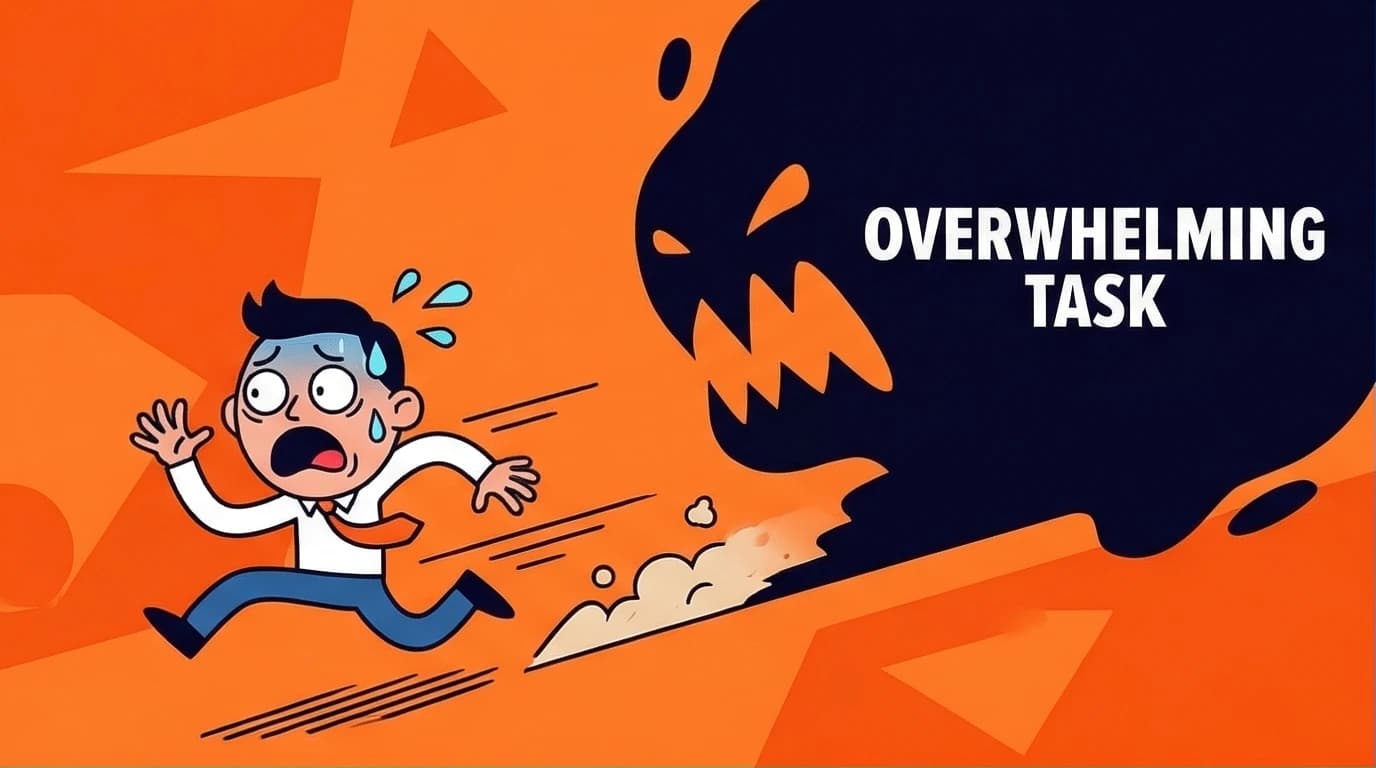
You stare at the blinking cursor on your screen, fully aware that a major deadline is inching closer. Instead of typing the first sentence, you suddenly decide to organize your desk, scroll through Amazon deals, or convince yourself that right now is the perfect time to clean the kitchen. The guilt compounds with every wasted minute. You watch the clock tick away, feeling increasingly frustrated, quietly asking yourself, why do I procrastinate when I know exactly what is at stake?
This cycle of delay and shame is exhausting. You buy new planners, download habit-tracking apps, and swear that tomorrow will be different. Yet, the pattern repeats. To break this loop, you need to stop treating your behavior as a character flaw. It is time to look at what is actually happening inside your brain.
Procrastination vs Laziness: The Crucial Difference
The heaviest burden you carry right now is the belief that you are simply lazy. Society often lumps these two concepts together, but psychologically, they are entirely different experiences. Understanding the dynamic of procrastination vs laziness is the fastest way to drop the guilt that keeps you stuck.
Laziness implies apathy. A truly lazy person avoids effort and feels absolutely fine about it. They do not want to do the work, they choose not to do it, and they experience zero remorse while resting.
Procrastination, on the other hand, is active psychological torment. You want to complete the task. You care deeply about the outcome. Yet, an invisible wall prevents you from starting. While a lazy person enjoys their inaction, a procrastinator suffers through it. You are not relaxing when you delay; you are burning massive amounts of mental energy worrying about the thing you are not doing. You are not broken, and you are not lazy. You are emotionally blocked.

The Psychology of Procrastination: A Battle in Your Brain
To figure out why you avoid your responsibilities, you have to look at the underlying psychology of procrastination. Modern behavioral science has shifted away from viewing procrastination as a time management failure. Instead, researchers recognize it as a coping mechanism gone awry.
Inside your brain, a constant tug-of-war exists between the limbic system (your primal emotional center, containing the amygdala) and the prefrontal cortex (the rational, future-planning center).
When you think about a difficult task—like writing a complex report, having a tough conversation, or doing your taxes—your brain associates that task with a negative emotion. It might be fear of failure, confusion, boredom, or imposter syndrome. Your amygdala perceives this negative emotion as a literal threat to your well-being. It sounds the alarm, urging you to escape the threat immediately.
Your prefrontal cortex tries to intervene, reminding you that the deadline is Friday and you need this job to pay your rent. But the limbic system operates much faster and stronger. To protect you from the immediate psychological discomfort, your brain seeks short-term mood repair. It guides you toward something safe and rewarding—like checking social media, organizing a bookshelf, or watching a video.
This is the essence of emotional regulation procrastination. Your brain is prioritizing immediate emotional relief over long-term goals. You delay the task to temporarily soothe your anxiety, trading tomorrow's success for today's comfort.
If you are fascinated by the hidden tug-of-war happening inside your mind and want to dive deeper into why your brain sabotages your productivity, there is some incredible literature that breaks this down. Patrick King offers a brilliant look at the biological and psychological triggers that cause us to delay our most important tasks. His work provides actionable frameworks to outsmart your own biology and stop letting your amygdala run the show.
The Science of Overcoming Procrastination
Patrick King
 41 Min
 8 Key Points
 4.6 Rate
If the thought of reading an entire book feels like another task to procrastinate on, you can start by absorbing the main ideas first.


LeapAhead

This app breaks down bestselling books on psychology and productivity into 15-minute summaries, helping you learn key strategies without the pressure of a full read.

Uncovering the Root Causes of Procrastination
If procrastination is a shield against negative emotions, what exactly are you trying to protect yourself from? The root causes of procrastination vary from person to person, but they generally fall into a few distinct psychological categories.
Perfectionism and the Fear of Failure
Many chronic procrastinators are actually terrified perfectionists. You hold yourself to such impossibly high standards that starting feels dangerous. The logic is twisted but protective: If I give it my 100% effort and fail, it means I am not smart or capable. But if I wait until the last minute and rush it, any failure is just a result of not having enough time. Delaying the work gives you a built-in excuse, protecting your fragile self-esteem from the sting of true failure.
Unlearning perfectionism is a massive undertaking, especially when it has functioned as your primary defense mechanism for years. If you frequently find yourself paralyzed by the fear of not doing something perfectly, Dr. Neil Fiore’s classic book is a must-read. He specifically addresses the link between perfectionism, guilt, and the tendency to delay, offering a comprehensive program to help you enjoy guilt-free play and highly productive work without the crushing pressure you put on yourself.
The Now Habit
Neil Fiore, Ph.D.
26 Min8 Key Points4.6 RateTask Ambiguity and Overwhelm
Your brain hates uncertainty. When a task lacks clear instructions or seems overwhelmingly large, your mind hits a wall. If your to-do list says "Launch new business" or "Write thesis," your brain does not know what the actual first physical step is. Faced with ambiguity, the brain opts for certainty. Doing the laundry provides a clear, immediate result. Tackling an ambiguous project does not.
The "Future Self" Disconnect
Psychologists use a concept called "temporal discounting" to explain why we make poor choices for our future. Functional MRI scans show that when people think about their "future self," the brain areas that light up are the same ones that light up when thinking about a complete stranger.
When you procrastinate, your brain genuinely believes that the stress of the deadline will be handled by someone else. You push the burden onto "Future You," failing to realize that Future You will have the exact same brain, the same same anxiety, and significantly less time.
When you procrastinate, your brain genuinely believes that the stress of the deadline will be handled by someone else. You push the burden onto "Future You," failing to realize that Future You will have the exact same brain, the same same anxiety, and significantly less time.

Low Frustration Tolerance
Sometimes the task is just incredibly boring. If a project requires tedious, repetitive effort without immediate reward, you will naturally pull away. In a world optimized for quick dopamine hits from TikTok, Apple Books, or instant Amazon deliveries, forcing your brain to endure an hour of unstimulating spreadsheet formatting feels physically uncomfortable.
How to Break the Cycle (Without Relying on Willpower)
Knowing the "why" is half the battle. The other half is changing the behavior. Because procrastination is an emotional issue, standard time management advice like "just make a schedule" will not work. You have to bypass the amygdala's threat response.
1. Forgive Yourself Immediately
The most counterintuitive but scientifically backed strategy to stop procrastinating is self-compassion. Studies show that students who forgive themselves for procrastinating before a midterm are significantly less likely to procrastinate before the final exam.
Guilt drains your mental energy. When you beat yourself up, you increase your stress levels, which makes the task feel even more threatening, triggering more procrastination. Break the loop. Acknowledge the delay without judgment: I avoided this yesterday because I was anxious. That is a normal human response. Today is a new opportunity.
Guilt drains your mental energy. When you beat yourself up, you increase your stress levels, which makes the task feel even more threatening, triggering more procrastination. Break the loop. Acknowledge the delay without judgment: I avoided this yesterday because I was anxious. That is a normal human response. Today is a new opportunity.
2. Shrink the Threat Level
If your brain views a two-hour work session as a massive emotional threat, do not try to work for two hours. Shrink the task until the brain no longer registers it as a threat.
Tell yourself you will only open the document and type one sentence. Or set a timer for just five minutes. Your goal is not to finish the project; your goal is simply to cross the starting line. Once you endure those first few minutes of friction, the anxiety usually dissipates. The momentum takes over, and you realize the task is not the monster your mind made it out to be.
Tell yourself you will only open the document and type one sentence. Or set a timer for just five minutes. Your goal is not to finish the project; your goal is simply to cross the starting line. Once you endure those first few minutes of friction, the anxiety usually dissipates. The momentum takes over, and you realize the task is not the monster your mind made it out to be.
The concept of shrinking the threat level is deeply rooted in the science of behavior design. When you make a behavior incredibly small, you bypass your brain's natural resistance and anxiety entirely. If you want to master the art of starting small and scaling up without relying on sheer willpower, Dr. BJ Fogg’s research is life-changing. He explains exactly how scaling back your expectations to ridiculously tiny actions is the secret to building lasting, effortless momentum.
Tiny Habits
BJ Fogg, Ph.D.
24 Min10 Key Points4.7 Rate3. Focus on the Next Physical Action
Remove ambiguity entirely. Never write "Work on presentation" on your to-do list. Ask yourself: What is the exact next physical movement I need to make?
Instead of a vague goal, define the action: "Open PowerPoint, title the first slide, and paste the data from the email." Making the action incredibly specific eliminates the cognitive heavy lifting that usually triggers delay.
Instead of a vague goal, define the action: "Open PowerPoint, title the first slide, and paste the data from the email." Making the action incredibly specific eliminates the cognitive heavy lifting that usually triggers delay.
4. Separate Your Identity from the Outcome
You must divorce your self-worth from your productivity. A bad first draft does not mean you are a bad writer. A failed project does not mean you are an incompetent professional. Give yourself permission to do a terrible job on the first attempt. You can always edit bad work; you cannot edit a blank page.
Tying your self-worth to your output is a surefire recipe for chronic stress and avoidance. Learning to embrace your flaws and accept that you are enough—even when your first draft is a total mess—is essential for lasting productivity and mental peace. Dr. Brené Brown’s research on vulnerability and perfectionism beautifully illustrates how to let go of the exhausting need to appear flawless. It is a powerful guide for anyone ready to cultivate self-compassion and courage in their daily life.

The Gifts of Imperfection
Brené Brown, Ph.D.
34 Min10 Key Points4.6 RateBuilding a new mindset takes time, and diving into all these books at once can feel overwhelming. A great way to start absorbing these powerful concepts is by listening to their key takeaways during your commute or a short break.
LeapAhead
Use your spare moments to listen to key insights from authors like Brené Brown and BJ Fogg, making it easier to build new habits without finding extra time.
These mindset shifts are foundational to changing your behavior. Once you've started practicing self-compassion and breaking down your tasks, you can supercharge your progress with specific productivity techniques.
Understanding the root of your delay is the first step. For some, this pattern may be connected to neurodivergence, where the experience of avoidance feels less like a choice and more like a mental roadblock.
FAQ
Is chronic procrastination a sign of ADHD or mental illness?
Not inherently. Everyone procrastinates to some degree. However, chronic, debilitating procrastination can be a symptom of underlying conditions like ADHD, clinical depression, or generalized anxiety disorder. If your inability to start tasks is severely impacting your career, relationships, or mental health despite trying various strategies, it is worth consulting a psychological professional.
Not inherently. Everyone procrastinates to some degree. However, chronic, debilitating procrastination can be a symptom of underlying conditions like ADHD, clinical depression, or generalized anxiety disorder. If your inability to start tasks is severely impacting your career, relationships, or mental health despite trying various strategies, it is worth consulting a psychological professional.
Why do I procrastinate even on things I actually enjoy doing?
This often comes down to transition friction. Switching from a low-energy state (like scrolling on your phone) to a higher-energy state (like setting up your painting supplies, tuning a guitar, or starting a video game) requires a brief spike in effort. Your brain naturally resists spending that transition energy, even if it knows the resulting activity will be fun.
This often comes down to transition friction. Switching from a low-energy state (like scrolling on your phone) to a higher-energy state (like setting up your painting supplies, tuning a guitar, or starting a video game) requires a brief spike in effort. Your brain naturally resists spending that transition energy, even if it knows the resulting activity will be fun.
Will buying a better planner or using productivity apps cure my procrastination?
No. Tools manage time, but procrastination is an emotional block. If you are terrified of failing a task, no calendar app in the world will make you do it. In fact, many people use "setting up a new productivity system" as a sophisticated form of procrastination. Focus on regulating your emotions and lowering the barrier to entry first; use the tools to organize your progress later.
No. Tools manage time, but procrastination is an emotional block. If you are terrified of failing a task, no calendar app in the world will make you do it. In fact, many people use "setting up a new productivity system" as a sophisticated form of procrastination. Focus on regulating your emotions and lowering the barrier to entry first; use the tools to organize your progress later.