

You assign a project to your team or a complex unit to your students. Half of them are stressed and overwhelmed. The other half are bored and checking their phones. Only a tiny fraction is actually dialed in, producing high-quality work with zero friction. You want everyone in that highly productive "zone," but relying on motivation or sheer willpower is a losing strategy.
Peak performance is not an accident. It is a highly structured psychological architecture. When you understand the specific triggers that create it, you can engineer environments that make deep focus the default rather than the exception.
Here is the exact framework to evaluate, design, and optimize any task using the fundamental principles of human psychology.
Core Elements of Flow Csikszentmihalyi Identified
Psychologist Mihaly Csikszentmihalyi pioneered the research on optimal experience. By studying artists, athletes, and scientists, he isolated the specific components that must be present for an individual to enter a state of absolute absorption.
To systematically build better curricula, operational workflows, or personal projects, you need to embed the 8 characteristics of flow directly into the architecture of the work.
1. Complete Concentration on the Task
The mind has a strict processing limit. Flow requires an environment where cognitive load is entirely dedicated to the task at a hand. There is no room for multitasking, background anxiety, or office distractions.
- Design Application: Kill context switching. In a corporate environment, this means establishing "no-meeting" blocks and minimizing asynchronous interruptions like Slack notifications. For educators, it means removing visual clutter from learning materials and breaking down complex topics so the student focuses on one single cognitive hurdle at a time.
2. Clarity of Goals
Confusion kills momentum. A person cannot enter a deep state of focus if they are constantly stopping to ask, "What exactly am I supposed to be doing right now?" The objective must be crystalline.
- Design Application: Vague directives like "improve the marketing strategy" or "study chapter four" guarantee friction. Transform these into precise targets. "Write a 500-word email sequence targeting cart abandonment" or "Solve these 10 quadratic equations using the factoring method."
3. Immediate Feedback
To stay in the zone, the brain needs real-time data on its performance. You need to know instantly if your current action moved you closer to the goal or further away. Without feedback, doubt creeps in, and doubt shatters focus.
- Design Application: Software developers experience this when their code compiles successfully or fails instantly. In management, replace annual reviews with weekly agile stand-ups. In education, utilize interactive learning platforms that instantly flag incorrect answers rather than waiting two weeks to return a graded paper.
4. Transformation of Time
When cognitive bandwidth is fully consumed by a task, the brain stops tracking time. Hours can feel like minutes, or conversely, a fast-paced sequence (like a rapid surgical procedure or a complex musical solo) can seem to slow down, allowing for hyper-precise reactions.
- Design Application: You cannot force this characteristic, but you can use it as a diagnostic metric. If your employees or students are constantly checking the clock, your task design is failing. It usually indicates a failure in characteristic #6 (the challenge/skill balance).
5. The Experience is Intrinsically Rewarding
Csikszentmihalyi referred to this as an "autotelic" experience—the doing of the task is its own reward. The individual is not solely focused on the future payout, promotion, or grade. The actual execution feels good.
- Design Application: Connect daily tasks to a broader, meaningful purpose. A customer service rep isn't just closing tickets; they are solving critical problems for real people. Gamification—using points, badges, or progress bars—can also synthesize intrinsic motivation in otherwise dry tasks.
Shifting away from standard "carrot and stick" external rewards is one of the hardest adjustments for traditional managers to make. If you are trying to figure out how to foster this kind of intrinsic motivation—where the work itself becomes the reward—understanding human behavioral psychology is key. There's a brilliant breakdown of why autonomy, mastery, and purpose are the true drivers of high performance. If you want to redesign your team's workflow to naturally inspire them, this is a fantastic resource to pick up.

Drive
Daniel H. Pink
 24 Min
 11 Key Points
 4.5 Rate
If you want to quickly absorb the core ideas from books like Drive without adding to your 'to-read' pile, you can get a head start with a summary.


LeapAhead

Learn the key principles of motivation from books like Drive in just 15 minutes, perfect for busy managers and leaders looking to inspire their teams.
6. A Balance Between Challenge and Skills
This is the absolute fulcrum of the entire flow framework. If the task is too hard, the person panics. If the task is too easy, the person checks out. Flow exists on the razor's edge where an individual's highest level of skill is met by an equally high challenge.
- Design Application: Dynamically scale difficulty. If an employee masters a process, immediately introduce a new variable or higher responsibility. Never leave top performers lingering in the comfort zone.
7. Actions and Awareness are Merged
In normal states, we overthink. We evaluate our actions as we do them. In flow, the barrier between the performer and the performance dissolves. The musician becomes the music; the coder becomes the software architecture. It feels completely effortless despite requiring immense exertion.
- Design Application: This requires intense practice and repetition of foundational skills. You cannot merge action and awareness if you are still learning the basic mechanics. Ensure your team or students have completely mastered the fundamentals before throwing them into complex, high-stakes scenarios.
8. A Feeling of Control Over the Task
The individual must believe they have agency. If success relies on random chance, shifting market variables, or the unpredictable mood of a micromanager, flow is impossible. The brain will not invest maximum cognitive energy if it knows the outcome is out of its hands.
- Design Application: Give your team autonomy. Define the "what" and the "why," but let them figure out the "how." In classrooms, offer students choices in how they demonstrate their knowledge, whether through an essay, a presentation, or a project.
If you really want to grasp the foundational science behind these eight elements, you should go straight to the source. Mihaly Csikszentmihalyi’s groundbreaking research remains the absolute gold standard for understanding how to engineer optimal experiences in business, education, and daily life. His work dives deeper into the specific psychology of how top athletes, artists, and business leaders consistently tap into this state of absolute absorption. This is essential reading for anyone serious about unlocking their team's full potential.
Flow
Mihaly Csikszentmihalyi
37 Min8 Key Points4.6 RateVisualizing Peak Performance: The Challenge vs Skill Flow Diagram
Understanding the elements is only half the battle. To actively diagnose why a team is failing or why a curriculum is falling flat, you must utilize the challenge vs skill flow diagram.
This matrix graphs Challenge Level on the vertical axis and Skill Level on the horizontal axis. Mapping where your people currently sit on this graph is the most effective management exercise you can conduct.
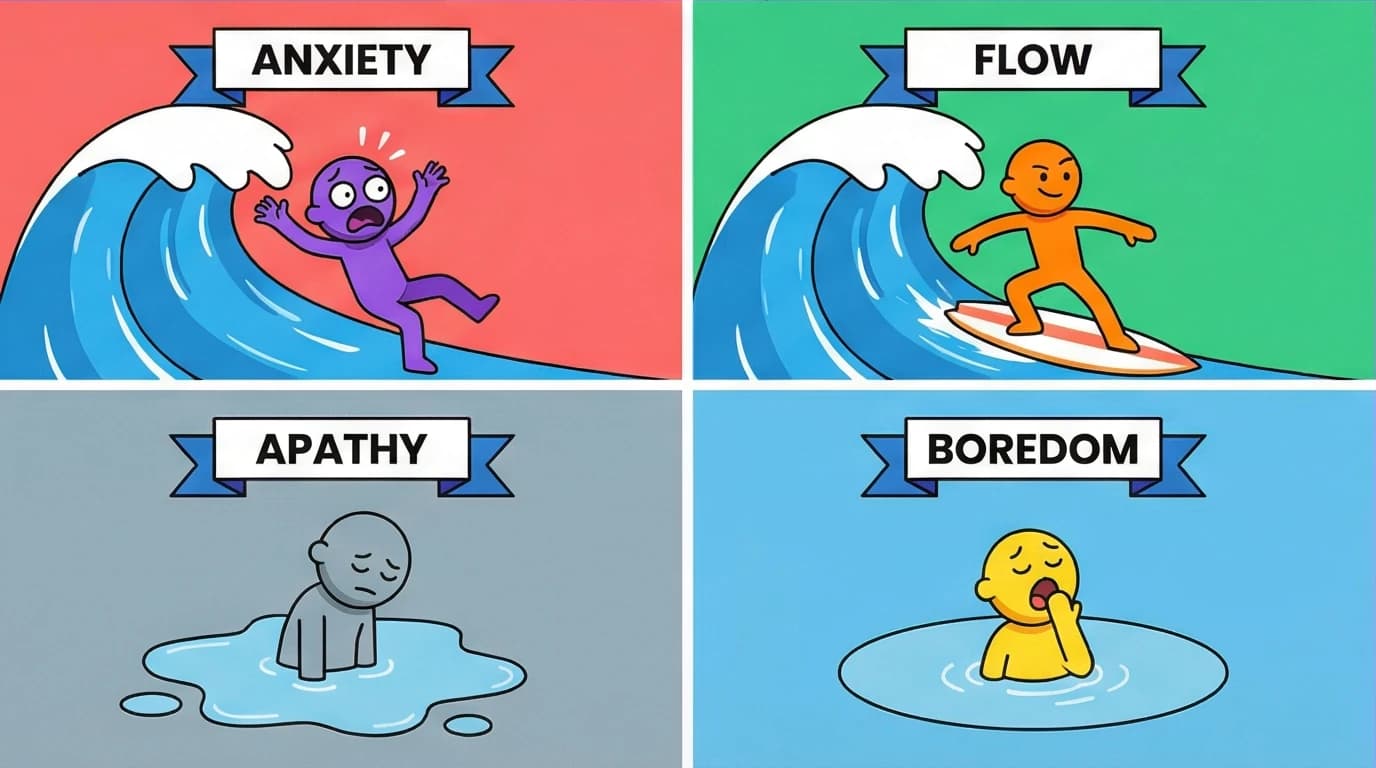
- Apathy (Low Skill, Low Challenge): Tasks like manual data entry or mindlessly clicking through a mandatory compliance video. Engagement is zero.
- Boredom (High Skill, Low Challenge): Your senior developer doing basic HTML updates. Your advanced math student doing basic addition worksheets. They are capable of much more, and their talent is rotting.
- Anxiety (Low Skill, High Challenge): Promoting a brilliant individual contributor to management with zero leadership training. Throwing a freshman into a senior-level seminar. The brain panics and shuts down.
- Arousal (Moderate Skill, High Challenge): This is the precursor to flow. The person is highly stimulated and learning rapidly but still making mistakes. They are fully engaged but lack the effortless mastery of flow.
- Flow (High Skill, High Challenge): The sweet spot. The task pushes the individual right to the absolute limit of their capabilities, forcing them to stretch without breaking.
Use this visual model to audit your workforce or classroom. Ask individuals directly: "On a scale of 1 to 10, how challenging is this project? On a scale of 1 to 10, how capable do you feel handling it?" If the numbers don't match, you must intervene and adjust the scope of work.
Establishing the Conditions for Flow State
You know the characteristics. You understand the model. Now you must build the environment. Establishing the optimal conditions for flow state requires ruthless prioritization and a willingness to dismantle traditional, outdated operational norms.
Step 1: Audit and Destroy Interruption Systems
The average American knowledge worker is interrupted every three to five minutes and takes roughly 23 minutes to return to a state of deep focus. Flow cannot survive in this ecosystem.
Implement mandatory deep work blocks. Use tools like Slack status updates to signal "Do Not Disturb" and build a culture where asynchronous communication is preferred over tapping someone on the shoulder.

Implement mandatory deep work blocks. Use tools like Slack status updates to signal "Do Not Disturb" and build a culture where asynchronous communication is preferred over tapping someone on the shoulder.
It is incredibly difficult to kill those interruption systems when modern corporate culture practically demands you stay glued to your inbox. If you need a tactical blueprint to help you—and your team—push back against the noise and carve out time for intense concentration, you need to rethink your approach to digital communication. Learning how to systematically cultivate periods of unbroken focus can completely transform your personal productivity and your company's bottom line.
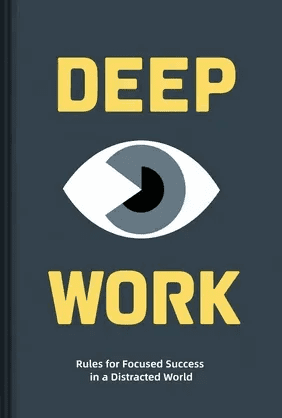
Deep Work
Cal Newport
47 Min8 Key Points4.6 RateApplying the principles of deep work is a challenge when your attention is constantly fragmented. If your schedule is too packed for long reading sessions, you can fit learning into the smaller gaps in your day.
LeapAhead
Use your commute or lunch break to learn productivity tactics from books like Deep Work with 15-minute audio and text summaries that fit any schedule.
Step 2: Scaffold the Challenges
You cannot drop a massive, vague project on a desk and expect flow. You must scaffold it.
Break a six-month product launch into two-week sprints. Break a semester-long thesis into weekly developmental milestones. This ensures goals remain clear and feedback remains immediate, satisfying characteristics #2 and #3.
Break a six-month product launch into two-week sprints. Break a semester-long thesis into weekly developmental milestones. This ensures goals remain clear and feedback remains immediate, satisfying characteristics #2 and #3.
Step 3: Match the Talent to the Trenches
Stop assigning work based solely on who has availability. Assign work based on the flow state model.
If an employee is currently in the "Boredom" sector of the matrix, give them the complex, high-risk problem. If a new hire is in the "Anxiety" sector, pair them with a mentor to elevate their skill level, or temporarily lower the challenge by breaking their task into smaller, less intimidating pieces.
If an employee is currently in the "Boredom" sector of the matrix, give them the complex, high-risk problem. If a new hire is in the "Anxiety" sector, pair them with a mentor to elevate their skill level, or temporarily lower the challenge by breaking their task into smaller, less intimidating pieces.
Step 4: Cultivate Psychological Safety
To achieve that critical feeling of control and minimize self-consciousness, people must know they are allowed to fail during the execution phase. If a single mistake leads to public reprimand, employees will hoard their cognitive resources for self-preservation rather than task execution. Build review processes that treat errors as data points for optimization rather than moral failings.
Building an environment that consistently fosters peak performance can feel like an uphill battle, but the payoff is monumental. When organizations manage to cultivate psychological safety and tap into collective flow, their output and innovation skyrocket. If you are fascinated by how elite groups—from Silicon Valley executives to Navy SEALs—hack their environments to consistently trigger these states and maximize human capability, this next recommendation will completely change how you view team dynamics.
Stealing Fire
Steven Kotler, Jamie Wheal, et al.
17 Min6 Key Points3.7 RateFAQ
Are all 8 characteristics of flow required at the exact same time?
Yes and no. The foundational conditions—clear goals, immediate feedback, and the challenge-skill balance—must be present to trigger the state. The subjective experiences—altered time perception, loss of self-consciousness, and merging of action and awareness—are the results of the state. You design for the conditions; the subjective characteristics happen naturally.
Yes and no. The foundational conditions—clear goals, immediate feedback, and the challenge-skill balance—must be present to trigger the state. The subjective experiences—altered time perception, loss of self-consciousness, and merging of action and awareness—are the results of the state. You design for the conditions; the subjective characteristics happen naturally.
How do you measure if a team is regularly experiencing a flow state?
Look at qualitative and quantitative markers. Quantitatively, output quality rises while error rates drop, and tasks are completed with fewer revision cycles. Qualitatively, you will notice a drop in workplace drama, less clock-watching, and employees demonstrating spontaneous proactive behavior—solving problems before you even ask them to.
Look at qualitative and quantitative markers. Quantitatively, output quality rises while error rates drop, and tasks are completed with fewer revision cycles. Qualitatively, you will notice a drop in workplace drama, less clock-watching, and employees demonstrating spontaneous proactive behavior—solving problems before you even ask them to.
What is the difference between hyperfocus and flow?
Hyperfocus is often an unmanaged, sometimes compulsive absorption in a task, frequently associated with ADHD. It can happen with low-value tasks (like scrolling social media or playing a simple video game) and often leads to exhaustion or neglecting important priorities. Flow is a constructive, highly organized psychological state resulting from a deliberate balance of high skill and high challenge that leaves the individual feeling energized and competent.
Hyperfocus is often an unmanaged, sometimes compulsive absorption in a task, frequently associated with ADHD. It can happen with low-value tasks (like scrolling social media or playing a simple video game) and often leads to exhaustion or neglecting important priorities. Flow is a constructive, highly organized psychological state resulting from a deliberate balance of high skill and high challenge that leaves the individual feeling energized and competent.
Can you force someone into a flow state?
No. Flow is a state of intrinsic motivation. You cannot mandate deep focus. As a manager or educator, your sole responsibility is environment design. You remove the friction, balance the difficulty, and provide the target. The individual must choose to step into the challenge.
No. Flow is a state of intrinsic motivation. You cannot mandate deep focus. As a manager or educator, your sole responsibility is environment design. You remove the friction, balance the difficulty, and provide the target. The individual must choose to step into the challenge.