


You are busy. Between endless notifications, demanding projects, and trying to maintain a personal life, your attention is highly fragmented. You want to feel deeply engaged and satisfied with your work, rather than just rushing to the finish line, completely drained. You have likely heard high-performers talk about "getting in the zone." That zone is what psychologist Mihaly Csikszentmihalyi calls Flow.
Reading his 300-page academic text might not fit into your schedule right now. This guide strips away the academic density. It gives you the exact mechanics of how to engineer focus, enjoy your work, and reclaim your attention without having to spend weeks reading the original text.
And if you want to apply this efficient learning approach to other classic books on psychology and productivity, but can't find the time, modern tools can help.

Grasp the key insights from dense but brilliant books like Flow in just 15 minutes, turning your commute or workout into valuable learning time.

Download LeapAhead App now
What Is Flow? The Core Concept
Any comprehensive Flow Mihaly Csikszentmihalyi summary must start with his foundational definition. Flow is the state in which people are so involved in an activity that nothing else seems to matter. The experience itself is so enjoyable that you will do it even at great cost, simply for the sheer sake of doing it.
During flow, your brain does not have room to process anxiety, worry about the future, or even keep track of time. Hours feel like minutes. You are not just surviving a task; you are mastering it. Csikszentmihalyi argues that human beings are most happy when they are in this state of optimal experience. Happiness is not a lucky accident or a result of buying the right things. It is a condition you create by ordering your consciousness and controlling your inner experience.
Flow Book Chapter Summary: Breaking Down the Optimal Experience
To save you time, this Flow book chapter summary groups the author's core arguments into four digestible themes. Csikszentmihalyi builds his case from the internal workings of the human mind all the way to finding lifelong meaning.
1. The Anatomy of Consciousness and Happiness (Chapters 1-3)
The book opens by challenging the modern pursuit of happiness. Wealth, status, and power do not guarantee a good life. The universe is chaotic, and human consciousness naturally drifts toward entropy—a state of disorder, anxiety, and distraction.
To combat this psychic entropy, you must actively order your mind. You do this by directing your attention toward specific, meaningful goals. When your attention is fully invested in a task that aligns with your goals, your consciousness falls into order. This ordered state is the breeding ground for happiness.
2. The Conditions of Flow (Chapters 4-5)
This is the mechanical core of the book. Csikszentmihalyi outlines the exact requirements to enter a flow state. It requires a delicate balance between the difficulty of a task and your ability to perform it.
- Apathy: Low skill, low challenge (e.g., watching mindless TV).
- Boredom: High skill, low challenge (e.g., doing routine data entry you mastered years ago).
- Anxiety: Low skill, high challenge (e.g., being asked to deliver a keynote speech on a topic you know nothing about).
- Flow: High skill, high challenge. You are pushing your limits, but you possess the exact tools needed to succeed.
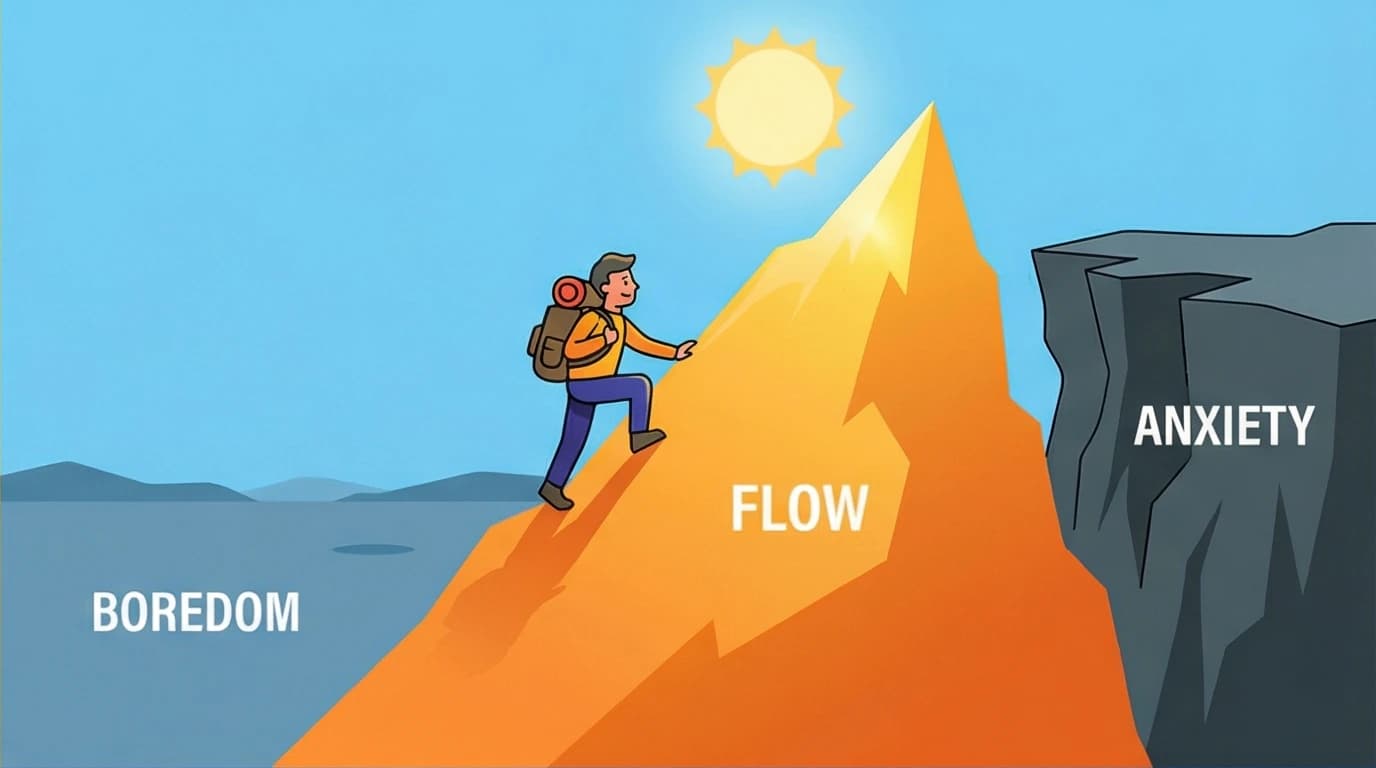
If you are anxious, you need to improve your skills. If you are bored, you need to artificially increase the challenge.
3. Flow in the Body, Mind, and Work (Chapters 6-8)
Flow is not restricted to elite athletes or artists. You can experience flow through physical activities like running miles, dancing, or even yoga, provided you set goals and measure progress.
Mental activities also generate flow. Reading, solving puzzles, and writing require intense concentration and yield deep internal rewards.
Crucially, the author addresses work. Many people view work as a necessary evil and leisure as the ultimate goal. Yet, Csikszentmihalyi's research reveals people experience flow more often at work than in their free time. Work has built-in goals, feedback, and challenges. Leisure time is often unstructured, leading to psychic entropy (boredom and restlessness). The goal is to develop an "autotelic" personality—someone who finds inherent value in the act of doing, turning even mundane jobs into complex games.
If you want to dive deeper into engineering a distraction-free work environment to consistently reach this mental state, Cal Newport's methodology is the absolute gold standard. Explicitly mentioned as a successor to Csikszentmihalyi's ideas, Newport builds directly on these concepts to help you eliminate shallow tasks and train your attention span. Whether you are coding a new app or writing a legal brief, this guide will help you produce elite-level professional results in a fraction of the time.
Deep Work
Cal Newport
 47 Min
 8 Key Points
 4.6 Rate
4. Resilience and Meaning (Chapters 9-10)
How do you maintain flow when tragedy strikes? The author introduces "transformational coping." This is the ability to take a negative, stressful situation and turn it into a new, solvable challenge.
Ultimately, flow is about more than just having good days at the office. It is about forging a unified life theme. When all your goals—career, family, personal growth—align into one overarching purpose, your entire life becomes a single, continuous flow experience.
Flow The Psychology of Optimal Experience Takeaways
If you want to skip the theory and get straight to the execution, here are the most critical Flow the psychology of optimal experience takeaways you can apply today.
1. Set Clear, Micro-Goals
You cannot enter flow without a target. Vague goals like "work on the marketing report" lead to distraction. Break the work down. A flow-inducing goal looks like: "Write the first 500 words of the executive summary in the next 30 minutes." The brain needs a specific focal point to lock onto.
2. Demand Immediate Feedback
Flow requires you to know exactly how well you are doing in real-time. A tennis player knows immediately if the ball lands out of bounds. In knowledge work, feedback is often delayed. You must create your own feedback loops. Track your word count, set a timer, or run your code to see if it compiles. You need a system that constantly tells you, "Yes, you are moving in the right direction."
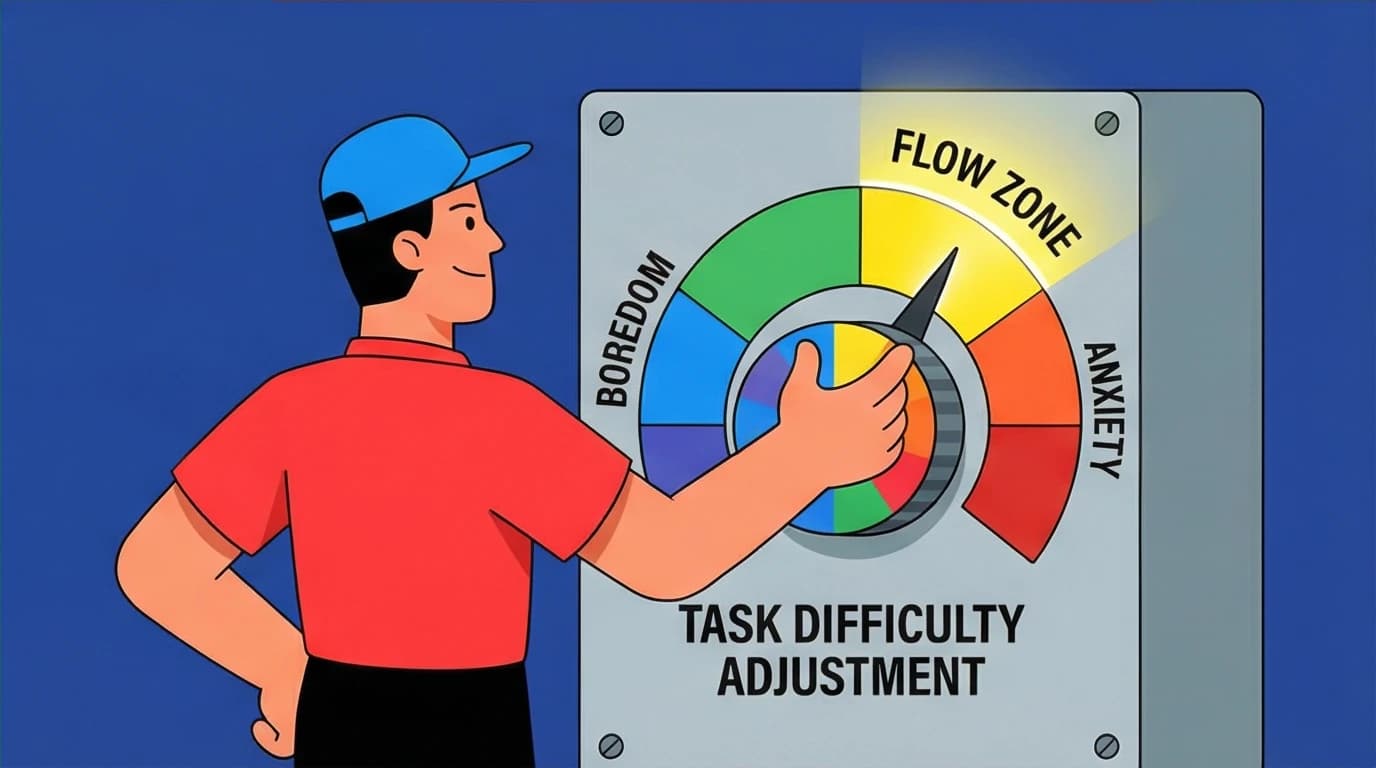
3. Adjust Your Own Difficulty Dial
If you are bored at work, do not blame your boss. Change the parameters of the task. If you have to write a routine email, challenge yourself to write it in half the time or use more persuasive language. If a project is making you anxious, break it down into smaller, manageable skills you can master one by one. You control the dial between boredom and anxiety.
4. Cultivate an Autotelic Personality
The word autotelic comes from Greek (auto = self, telos = goal). Stop doing things purely for the external reward (the paycheck, the promotion, the grade). Focus on the intrinsic reward of mastering the task itself. When the action is the reward, you become immune to external stress.
Shifting your mindset from chasing external rewards—like a fatter paycheck or a corner office—to embracing the intrinsic joy of the work itself is a massive paradigm shift. If you are struggling to find that internal drive, Daniel H. Pink brilliantly breaks down the modern science of human motivation. He proves that autonomy, mastery, and purpose are the true keys to high performance, helping you build that autotelic personality from the ground up.

Drive
Daniel H. Pink
24 Min11 Key Points4.5 Rate5. Reclaim Your Leisure Time
Stop defaulting to the couch and the TV. Passive entertainment requires zero skill and offers zero challenge; it will never produce flow. Invest your free time in active hobbies. Read challenging books, learn an instrument, or build something. Treat your leisure time with the same intentionality as your career.
Transforming your leisure time from mindless couch-surfing into intentional, flow-inducing hobbies requires a solid system. Let's be honest: relying on sheer willpower after a long, exhausting commute home rarely works. James Clear, another author heavily influenced by the science of flow, provides an incredibly practical, step-by-step framework. He shows you exactly how to design an environment where picking up a book, running a few miles, or practicing an instrument becomes the automatic, frictionless choice.
Atomic Habits
James Clear
26 Min7 Key Points4.7 RateHonest Flow Book Review: Should You Read It?
You have the core concepts, but does that mean you should skip the book entirely? Here is a practical Flow book review based on what you actually need.
The Good:
Csikszentmihalyi’s work is foundational. Nearly every modern productivity expert, from Cal Newport (Deep Work) to James Clear (Atomic Habits), draws heavily from Flow. The book provides profound, research-backed insights into human happiness. It shifts the paradigm from seeking external validation to building internal control.
Csikszentmihalyi’s work is foundational. Nearly every modern productivity expert, from Cal Newport (Deep Work) to James Clear (Atomic Habits), draws heavily from Flow. The book provides profound, research-backed insights into human happiness. It shifts the paradigm from seeking external validation to building internal control.
The Drawbacks:
Published in 1990, the book is highly academic. The language can be dense, and the author often relies on long, philosophical tangents. It is not formatted like a modern self-help book. You will not find bulleted summaries at the end of each chapter. It requires patience.
Published in 1990, the book is highly academic. The language can be dense, and the author often relies on long, philosophical tangents. It is not formatted like a modern self-help book. You will not find bulleted summaries at the end of each chapter. It requires patience.
For those who appreciate the ideas but find the academic style to be a barrier, getting a streamlined explanation of the core concepts can be a great starting point.
Breaks down the core ideas of academically dense books, so you can understand the essential psychology of Flow without getting bogged down in philosophical tangents.
Download LeapAhead App now
The Verdict:
If your core intent is simply to boost your focus at work and understand how to balance challenge and skill, this summary provides exactly what you need. You can implement these takeaways without reading another word.
If your core intent is simply to boost your focus at work and understand how to balance challenge and skill, this summary provides exactly what you need. You can implement these takeaways without reading another word.
However, if you are fascinated by the deep psychology of human happiness and want to explore detailed case studies of people who survived extreme conditions by mastering their consciousness, the full book is entirely worth your time. Pick up a physical copy at Barnes & Noble to annotate, or download it on Audible to absorb the philosophy during your commute.
Ready to experience the psychology of optimal experience firsthand? While this guide gives you the tactical execution, reading Mihaly Csikszentmihalyi’s original masterpiece will fundamentally rewire how you view happiness, focus, and the human mind. Grab your own copy below to dive into the profound research, historical context, and fascinating case studies that have inspired today's top productivity experts and high-performers across the United States and beyond.
Flow
Mihaly Csikszentmihalyi
37 Min8 Key Points4.6 RateFAQ
What is the main point of the book Flow?
The main point is that true happiness and satisfaction do not come from passive leisure or external rewards, but from engaging in "flow." This is a state of deep concentration achieved by perfectly matching your current skills with an appropriately high challenge.
The main point is that true happiness and satisfaction do not come from passive leisure or external rewards, but from engaging in "flow." This is a state of deep concentration achieved by perfectly matching your current skills with an appropriately high challenge.
What is the difference between flow and hyperfocus?
Hyperfocus is often a reactive state, frequently associated with ADHD, where you get locked into an activity (like scrolling or playing a video game) but may feel drained or guilty afterward. Flow is a highly intentional, active state of mastery that leaves you feeling energized, accomplished, and in control of your consciousness.
Hyperfocus is often a reactive state, frequently associated with ADHD, where you get locked into an activity (like scrolling or playing a video game) but may feel drained or guilty afterward. Flow is a highly intentional, active state of mastery that leaves you feeling energized, accomplished, and in control of your consciousness.
How can I trigger a flow state at a boring job?
You must artificially inject challenges into your routine tasks. If you do data entry, challenge yourself to beat your personal time record without making a mistake. If you work in retail, challenge yourself to learn something new about every customer. Turn the mundane task into a complex game with clear rules and immediate feedback.
You must artificially inject challenges into your routine tasks. If you do data entry, challenge yourself to beat your personal time record without making a mistake. If you work in retail, challenge yourself to learn something new about every customer. Turn the mundane task into a complex game with clear rules and immediate feedback.
Is Flow a practical self-help book?
Not in the modern sense. It is a psychological thesis backed by decades of research. It provides a powerful framework for living a better life, but it requires you to extract the practical steps yourself. It tells you why optimal experience happens, rather than giving you a 10-step checklist for your morning routine.
Not in the modern sense. It is a psychological thesis backed by decades of research. It provides a powerful framework for living a better life, but it requires you to extract the practical steps yourself. It tells you why optimal experience happens, rather than giving you a 10-step checklist for your morning routine.