

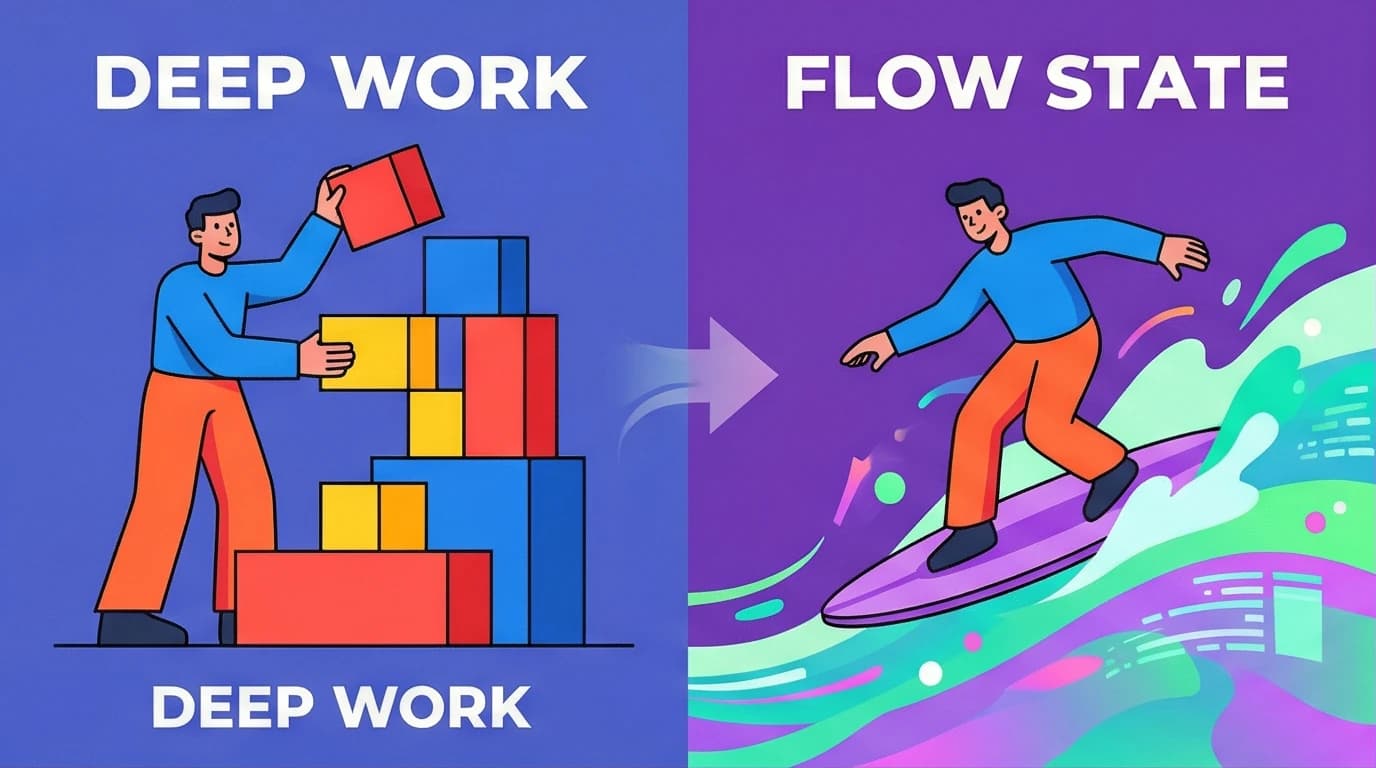
You block out three hours on your Google Calendar, turn on your noise-canceling headphones, and silence your Slack notifications. You sit down expecting a wave of effortless productivity to wash over you. Instead, you feel restless, mentally drained, and frustrated that the work still feels so hard. You start wondering if you are doing something wrong, or if you just lack the natural ability to focus like the top performers in your field.
This frustration happens when you confuse a productivity strategy with a psychological state. To actually get things done without burning out, you need to dissect deep work vs flow state, understand how they interact, and structure your day to leverage both. Before we compare them, it is helpful to have a solid grasp of the underlying science.
The Origins: Cal Newport vs Mihaly Csikszentmihalyi
To understand how to use these concepts, you need to look at where they came from. They were developed decades apart by two completely different thinkers analyzing human performance from different angles.
Mihaly Csikszentmihalyi and the Flow State
In the 1970s, psychologist Mihaly Csikszentmihalyi studied artists, musicians, and athletes who would get so absorbed in their activities that they ignored hunger, fatigue, and time. He coined the term "flow" to describe this optimal state of consciousness where you feel and perform your best. Flow is characterized by a loss of self-consciousness, effortless momentum, and intrinsic reward. The activity itself becomes the goal.
In the 1970s, psychologist Mihaly Csikszentmihalyi studied artists, musicians, and athletes who would get so absorbed in their activities that they ignored hunger, fatigue, and time. He coined the term "flow" to describe this optimal state of consciousness where you feel and perform your best. Flow is characterized by a loss of self-consciousness, effortless momentum, and intrinsic reward. The activity itself becomes the goal.
Csikszentmihalyi identified several key components that make up this unique state of mind, from having clear goals to the merging of action and awareness.
If you are fascinated by the psychology behind this optimal state of consciousness, going straight to the source is incredibly rewarding. Mihaly Csikszentmihalyi’s foundational research lays out exactly how high performers across various fields—from Olympic athletes to world-class musicians—harness this phenomenon. His groundbreaking book explores the mechanics of pure immersion and explains how you can cultivate more of these intrinsically rewarding experiences in your own daily life. It is a must-read for anyone serious about unlocking their peak potential.
Flow
Mihaly Csikszentmihalyi
 37 Min
 8 Key Points
 4.6 Rate
Cal Newport and Deep Work
Fast forward to 2016. Computer science professor Cal Newport looked at the modern knowledge worker drowning in emails, instant messaging, and algorithmic feeds. He introduced "deep work," defining it as professional activities performed in a state of distraction-free concentration that push your cognitive capabilities to their limit. Deep work is a hard, practical skill designed to create rare value in a distracted economy.
Fast forward to 2016. Computer science professor Cal Newport looked at the modern knowledge worker drowning in emails, instant messaging, and algorithmic feeds. He introduced "deep work," defining it as professional activities performed in a state of distraction-free concentration that push your cognitive capabilities to their limit. Deep work is a hard, practical skill designed to create rare value in a distracted economy.
If you find yourself constantly losing the battle against notifications, overflowing inboxes, and endless Slack threads, you might need a complete framework overhaul. Cal Newport’s defining guide on this subject is a masterclass in reclaiming your cognitive real estate. It offers incredibly practical, no-nonsense strategies for training your brain to ignore the noise and focus intensely on high-value tasks. For any knowledge worker feeling overwhelmed by the modern distraction economy, this read is an absolute game-changer.
Deep Work
Cal Newport
47 Min8 Key Points4.6 RateReading these foundational texts is a great first step, but finding the time can be a challenge in itself. If you want to absorb the core ideas from authors like Newport and Csikszentmihalyi without dedicating weeks to reading, a microlearning app can be a great place to start.


Get the key insights from bestselling books on focus and productivity, like Deep Work and Flow, in just 15-minute audio or text summaries.
 LeapAhead
The Core Differences You Need to Know
While both concepts involve intense focus, they sit on entirely different layers of your productivity stack.
1. Action vs. State of Mind
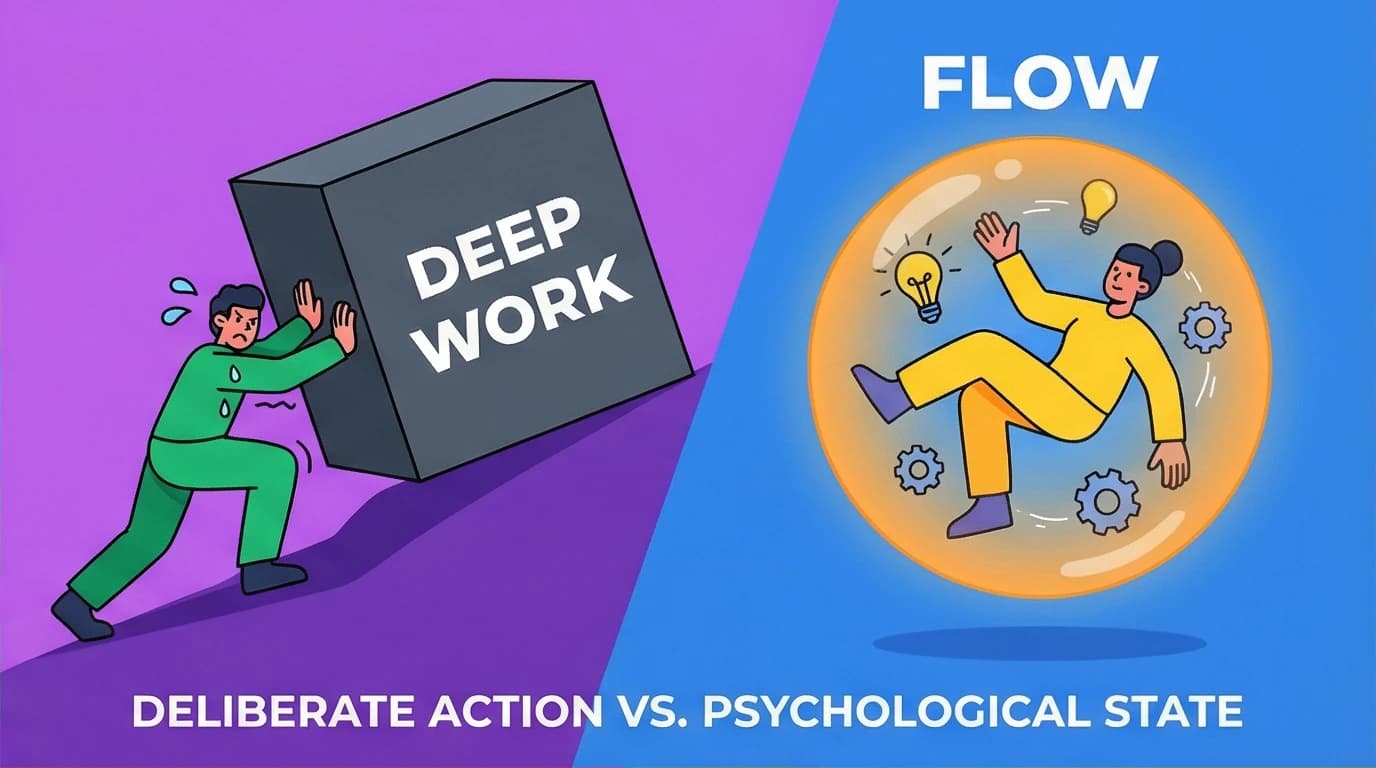
Deep work is something you do. It is a habit you put on your calendar. You can sit down, do two hours of deep work writing code or analyzing a financial model, and never actually feel good doing it.
Flow is something you experience. It is a neurological state. You cannot schedule flow on a calendar from 2:00 PM to 4:00 PM. You can only set up the right conditions and hope it arrives.
2. The Role of Effort and Friction
Deep work is inherently difficult. Pushing your brain to learn a complex AWS architecture or write a high-level product requirements document requires burning significant mental calories. It often feels like lifting heavy weights.
Flow feels effortless. When you are in it, the friction disappears. The next line of code or the next sentence comes to you automatically.
3. The Necessity of a Goal
Deep work is strictly tied to creating professional or tangible value. You do not do deep work while surfing or painting a picture for fun. Flow, however, can happen anywhere. You can experience flow while playing basketball, playing a guitar, or cooking dinner.
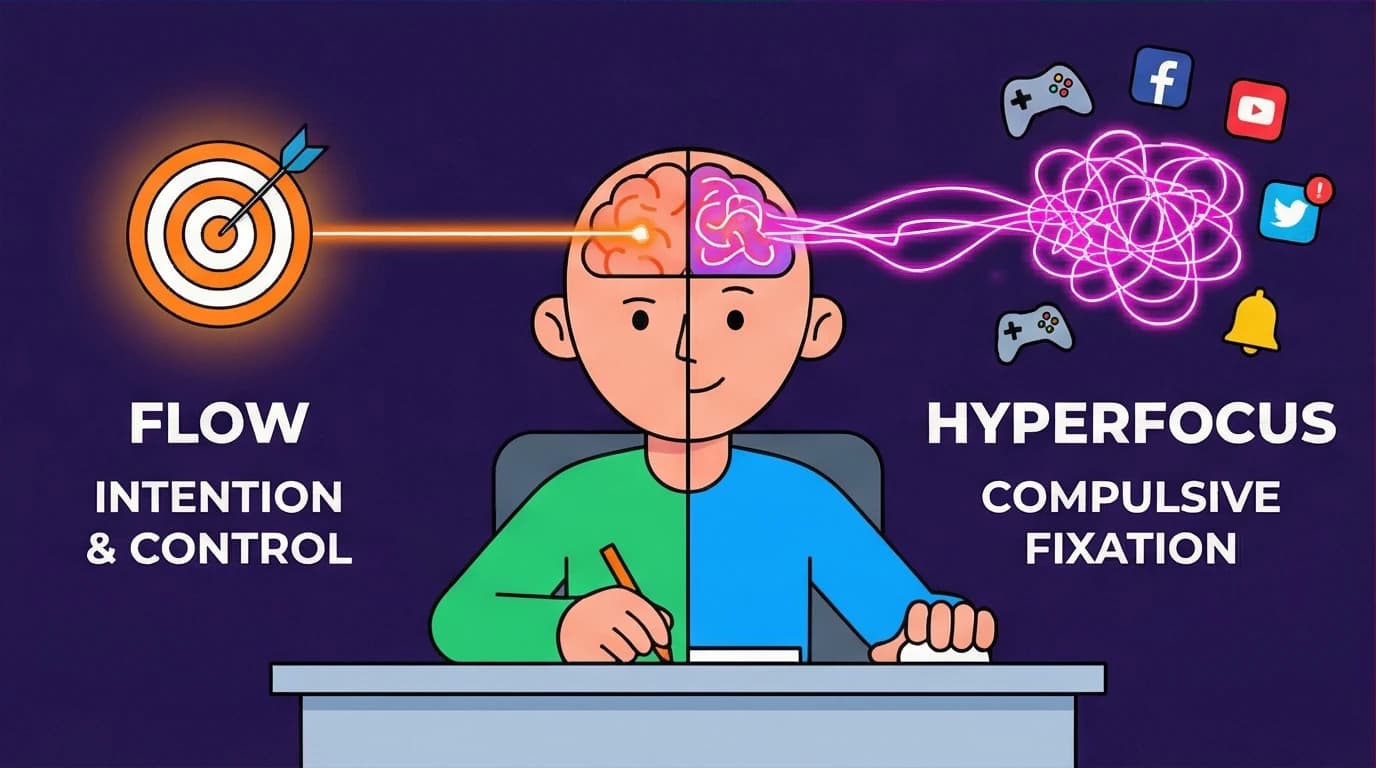
Difference Between Flow and Hyperfocus
Before building a system around these concepts, we have to isolate a massive productivity trap: hyperfocus.
Many tech workers confuse flow with hyperfocus. Hyperfocus is an intense fixation on a specific task or topic, often to the detriment of everything else around you. It is frequently associated with ADHD.
The main difference between flow and hyperfocus lies in intention and control. Flow is a highly regulated, optimal experience. You are challenged, your skills are matched to the task, and you are working toward a clear, constructive goal.
Hyperfocus is often unregulated and compulsive. Spending six hours deep-diving into a Wikipedia rabbit hole about the Roman Empire or losing track of a whole Sunday playing video games is hyperfocus. It drains your energy and leaves you feeling groggy, whereas flow generally leaves you feeling energized and accomplished.
Understanding the fine line between productive flow and exhausting hyperfocus is a crucial step in managing your mental energy. If you want to dive deeper into how your brain directs its attention—and how to stop accidentally losing hours to the wrong tasks—learning the science behind your focus is highly beneficial. There are fantastic resources available that break down how to intentionally manage both your concentrated and scattered attention. If you are looking to regain control over your wandering mind, this insightful guide provides actionable techniques to harness your focus purposefully.
Hyperfocus
Chris Bailey
17 Min7 Key Points4.6 RateWhich is Better Deep Work or Flow?
If you search productivity forums, you will inevitably see people asking: which is better deep work or flow?
This is a fundamentally flawed question. It is like asking if a steering wheel is better than a moving car. You need both to reach your destination effectively.
Deep work is the mechanism you use to clear the runway. Flow is the takeoff. If you only chase flow, you will end up waiting for "inspiration" to strike, which is a terrible strategy for a professional who has deadlines. If you only do brutal, grinding deep work without ever hitting a flow state, you will eventually burn out because the cognitive load remains too high without the emotional reward that flow provides.
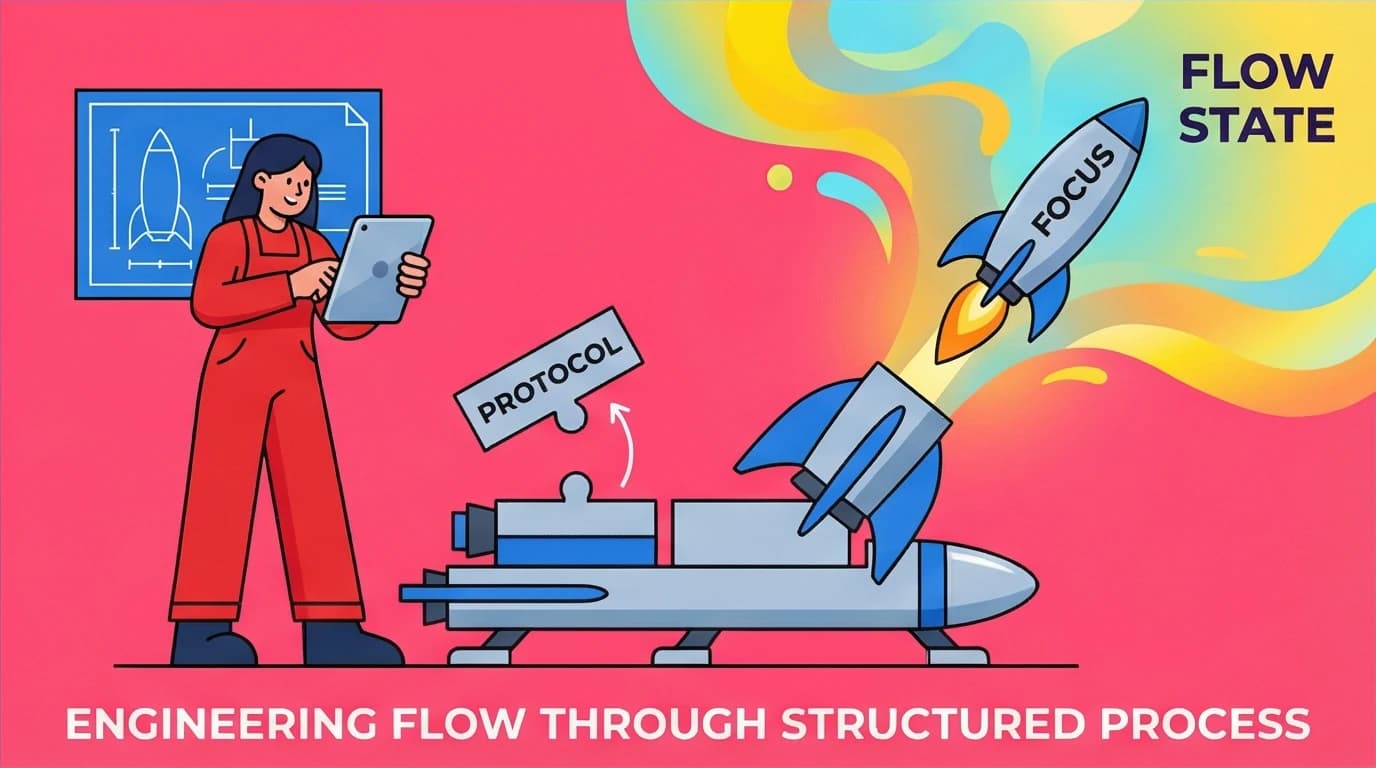
The Protocol: Engineering Flow Through Deep Work
To maximize your output and protect your mental energy, you need to use the strict parameters of deep work to reliably trigger the psychological ease of flow. Here is the exact framework to make that happen.
Step 1: Schedule the Deep Work Block
Flow requires uninterrupted attention. You cannot reach a flow state if you are checking Amazon deliveries or responding to Slack every five minutes. Block out 90 to 120 minutes on your calendar. Close all unneeded browser tabs. Put your phone in another room. You are building the physical boundaries of deep work.
Step 2: Calibrate the Challenge-Skill Ratio
Csikszentmihalyi’s research showed that flow only happens when your skill level perfectly matches the challenge of the task.
- If the task is too hard, you feel anxiety.
- If the task is too easy, you feel boredom.
If you are starting a deep work session and feeling anxious, break the problem down into smaller, manageable chunks. If you are bored, artificial constraints—like giving yourself a tighter deadline—can increase the challenge and push you into flow.
Step 3: Define Clear Goals and Immediate Feedback
Flow demands knowing exactly what you need to do and knowing immediately if you are doing it right. "Work on the marketing project" is too vague for your brain to engage with. "Write the first 500 words of the landing page copy" gives you a precise target.
Step 4: Endure the Transition Friction
This is where most people fail. The first 15 to 20 minutes of a deep work session usually suck. Your brain is craving the cheap dopamine of social media. It will try to convince you that you are hungry, thirsty, or need to check your email just one more time.
Acknowledge this friction. Expect it. Do not mistake this initial discomfort as a sign that you are not capable of flow. If you force yourself to stare at the problem and work through those first 15 minutes of resistance, the friction usually dissolves, and the flow state takes over.
This four-step protocol is a powerful way to structure your work sessions, but it's not the only method. There are numerous other focus techniques and mental models you can use to prime your brain for peak performance.
Building a reliable protocol for deep work sounds great in theory, but overcoming that initial 15-minute friction is where the real battle lies. Your brain's addiction to quick dopamine hits is a powerful adversary, and sometimes willpower simply isn't enough to keep you on track. To bulletproof your environment and finally break the cycle of constant interruptions, you need to understand the internal triggers that drive you to check your phone. If you are ready to build indestructible focus habits, this step-by-step framework will teach you exactly how to master your time.
Indistractable
Nir Eyal
23 Min10 Key Points4.5 RateBuilding a new productivity system from books takes commitment. If the idea of adding more to your reading list feels overwhelming, you can get a head start by learning the most crucial concepts first during your commute or workout.
This app helps you clear your "reading debt" by summarizing essential lessons from books on focus, so you can start applying them today instead of someday.
LeapAheadFAQ
Can you do deep work without being in a flow state?
Yes. Deep work requires intense concentration and pushes your cognitive limits, but it does not always trigger the effortless, timeless feeling of flow. Sometimes, doing hard things just stays hard the entire time. It is still highly productive deep work, even if it feels like a grind.
Yes. Deep work requires intense concentration and pushes your cognitive limits, but it does not always trigger the effortless, timeless feeling of flow. Sometimes, doing hard things just stays hard the entire time. It is still highly productive deep work, even if it feels like a grind.
How long should a deep work or flow session last?
Human cognitive limits dictate that you cannot maintain peak concentration indefinitely. Most productivity experts and neuroscientists recommend blocking out 90 to 120 minutes. After that, your attention span degrades, and diminishing returns set in. Beginners should start with 45-minute blocks and build their cognitive endurance.
Human cognitive limits dictate that you cannot maintain peak concentration indefinitely. Most productivity experts and neuroscientists recommend blocking out 90 to 120 minutes. After that, your attention span degrades, and diminishing returns set in. Beginners should start with 45-minute blocks and build their cognitive endurance.
Is flow always productive?
No. Flow is a state of optimal experience, not necessarily optimal economic productivity. You can be in a complete state of flow while organizing your Spotify playlists or reformatting the color scheme of a spreadsheet that does not matter. This is why you must use deep work to dictate what you focus on, ensuring your flow state is directed at high-value tasks.
No. Flow is a state of optimal experience, not necessarily optimal economic productivity. You can be in a complete state of flow while organizing your Spotify playlists or reformatting the color scheme of a spreadsheet that does not matter. This is why you must use deep work to dictate what you focus on, ensuring your flow state is directed at high-value tasks.